Quick Answer
The clearest difference between curtain bangs and wispy bangs is that they describe two different features. Curtain bangs describe shape. They usually open near the center, start shorter around the middle, and get longer as they sweep toward the temples or cheekbones. Wispy bangs describe density. They use less hair, show small gaps between strands, and let more of the forehead remain visible.
That means the two names are not mutually exclusive. You can have full curtain bangs, wispy curtain bangs, straight-across wispy bangs, or side-swept wispy bangs. When someone compares curtain bangs vs wispy bangs, they are usually picturing the classic versions: a stronger center-open frame versus a lighter fringe that falls more directly across the forehead.
Choose classic curtain bangs when you want the sides of the fringe to shape the face and blend into layers. Choose traditional wispy bangs when you want a subtle fringe with light forehead coverage. Choose wispy curtain bangs when you like the outward sweep of curtain bangs but do not want a thick or dramatic frame.
Curtain is the direction and shape. Wispy is the amount of hair and separation.
What Is the Real Difference Between Curtain Bangs and Wispy Bangs?
Classic curtain bangs are built around an opening. The shortest pieces sit near the center of the forehead, while the sides become progressively longer. Styling usually encourages those sides to bend away from the face, which creates a diagonal line around the eyes, temples, and cheekbones. Depending on the length, the outer pieces may blend into cheekbone, jaw, or longer face-framing layers.
Traditional wispy bangs are built around lightness. Small sections sit across the forehead with visible separation instead of forming one solid line. The center does not need to open, and the sides do not need to sweep toward the cheeks. The effect can be soft, airy, and less visually dominant than full fringe.
The dedicated wispy bangs guide goes deeper on fringe width, long-hair pairings, round-face adjustments, texture, clumping, and grow-out. Use this comparison page when the decision is specifically curtain shape versus wispy density.
The distinction matters at the salon. If you ask only for "wispy bangs," your stylist still needs to know where the fringe should fall and whether you want a center part. If you ask only for "curtain bangs," your stylist still needs to know how full or light you want them. Shape and density are separate decisions.
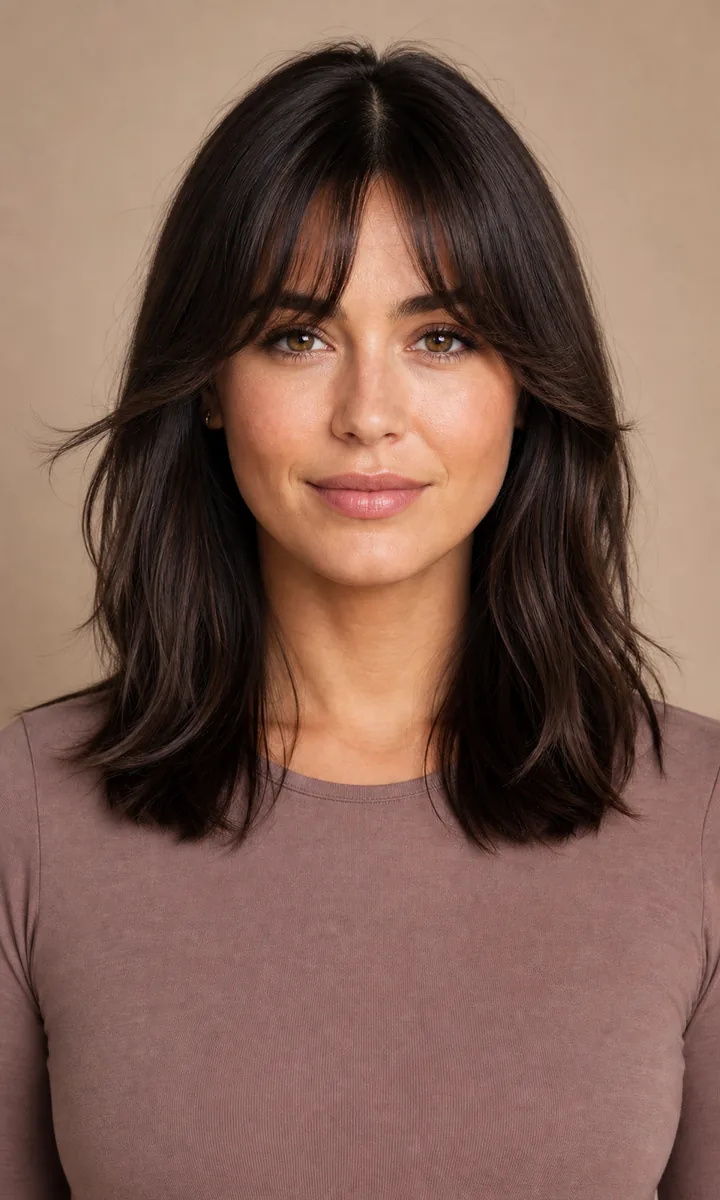 The center opening and longer side pieces are what make this fringe read as curtain bangs.
Curtain Bangs vs Wispy Bangs Comparison
| Factor |
Curtain Bangs |
Wispy Bangs |
| Main definition |
A center- or near-center-open shape that gets longer toward the sides |
A light-density fringe with separated strands |
| Typical direction |
Sweeps outward and away from the center |
Often falls forward, though it can also sweep sideways |
| Forehead coverage |
Open through the center with more framing at the sides |
Light coverage across more of the forehead |
| Density |
Can be wispy, medium, or full |
Intentionally light and separated |
| Shortest point |
Often near the brows, eyes, or upper cheek area |
Commonly near the brows, but length can vary |
| Side blend |
Usually an important part of the cut |
Optional; may remain separate from the side layers |
| Visual effect |
Stronger face framing and cheekbone emphasis |
Softer, lighter, more delicate fringe |
| Daily styling |
Often needs root direction and an outward bend |
May need refreshing when strands separate or clump |
| Grow-out |
Longer sides can blend into face-framing layers |
May pass through a forward-fringe in-between stage |
| Best starting point |
You want visible framing without a straight solid fringe |
You want a subtle fringe without heavy coverage |
Use the table to identify the feature you care about most. If your priority is the diagonal frame around the sides of the face, focus on curtain shape. If your priority is keeping the fringe light, focus on wispy density. If both matter, bring references that show a wispy curtain combination rather than forcing yourself to choose one label.
Can Curtain Bangs Be Wispy?
Yes. Wispy curtain bangs are one of the most useful combinations for someone who wants face framing without a heavy fringe. They keep the center opening and longer outer pieces associated with curtain bangs, but use less hair and allow more separation between strands.
This overlap is also why hairstyle photos can be confusing. One article may label a look "curtain bangs" because of the center-open shape. Another may call the same look "wispy bangs" because the fringe is light. Both descriptions can be accurate. Instead of arguing over the name, look at four visible details:
- Where does the fringe naturally open?
- How much forehead remains visible?
- Where do the shortest pieces land?
- How far do the outer pieces extend toward the cheeks or jaw?
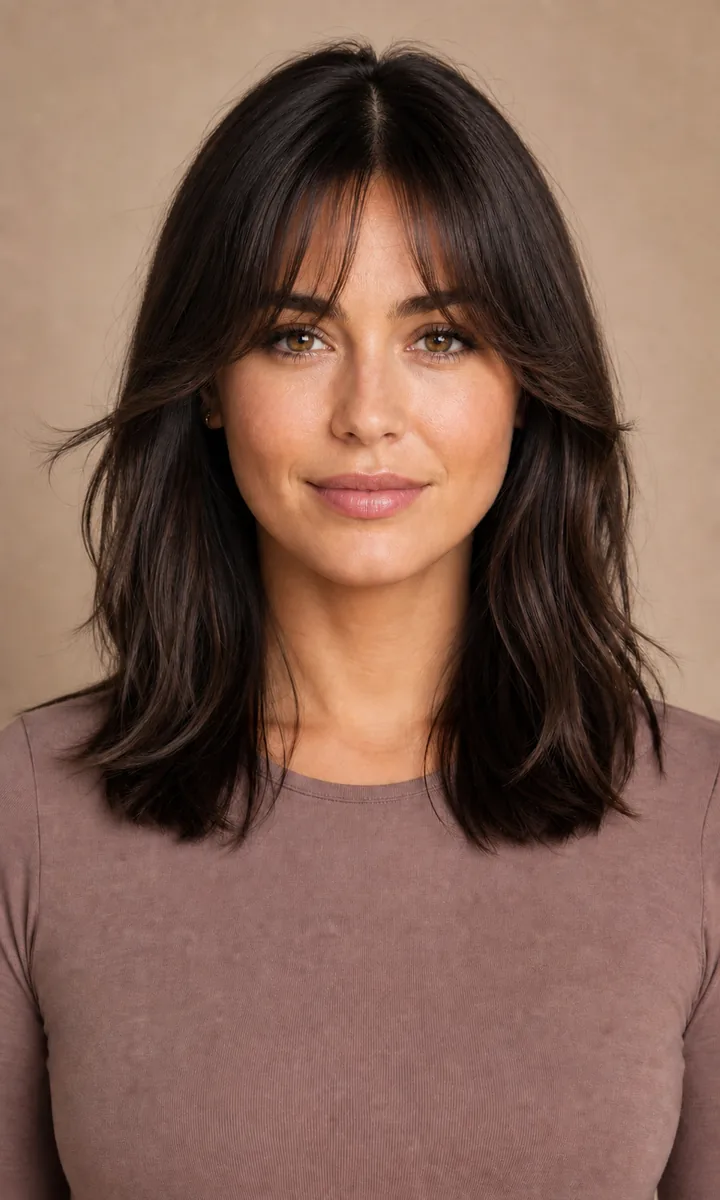 This hybrid keeps the curtain direction while reducing density through the fringe.
A wispy curtain version can feel lower commitment than a short, full curtain fringe, but it is not maintenance-free. The lighter sections may lose their outward bend faster, especially when the roots naturally grow forward or the forehead becomes oily. The right choice depends on how your hair behaves, not just how little hair is cut.
Compare the Face Frame, Not Just the Fringe
Bangs change the relationship between your forehead, eyes, cheekbones, and the rest of the haircut. Curtain bangs move attention toward the center opening and then lead the eye outward along the sides. Traditional wispy bangs create a softer horizontal area across the forehead without building the same side frame.
For a fair visual comparison, keep the person, camera angle, expression, hair color, and base haircut the same. The two images below follow that approach. The important difference is where the fringe sits: outward and open for curtain bangs, lightly forward for wispy bangs.
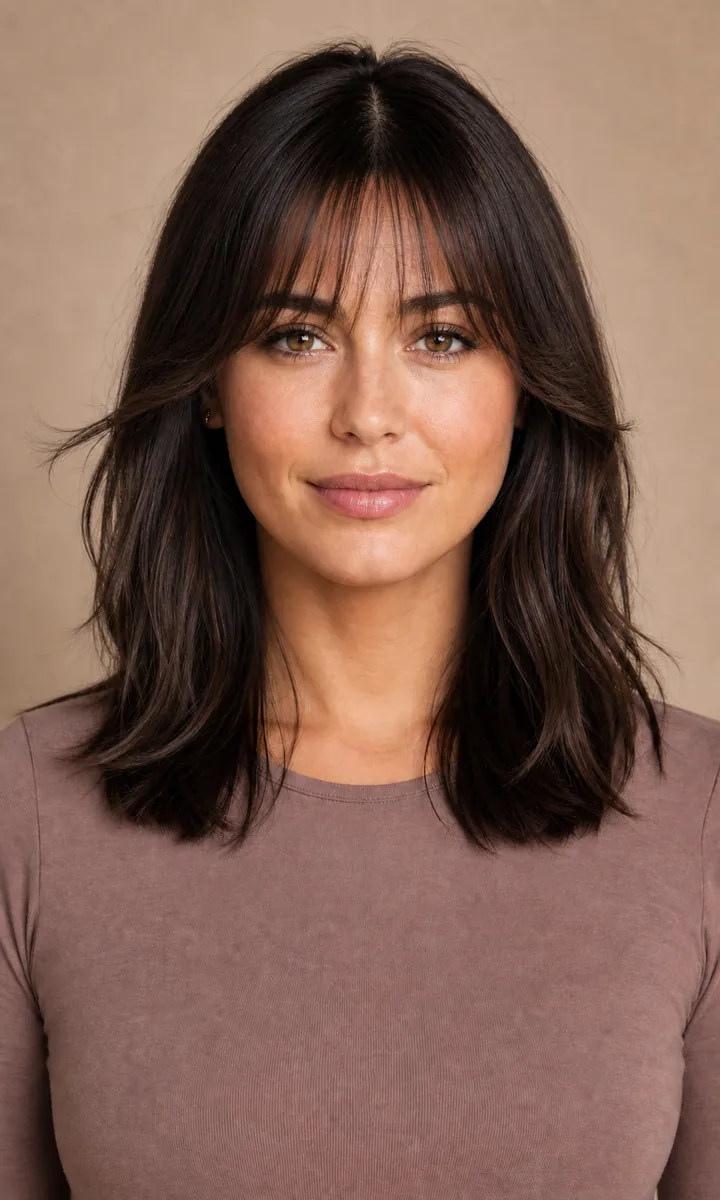 Traditional wispy bangs add a light veil across the forehead instead of creating a strong center-open frame.
Do not decide based only on which portrait looks more polished. Check how much of the brows and forehead remain visible. Notice whether the side pieces emphasize the cheekbones or make the face feel wider. Look at whether the shortest strands feel connected to the rest of the haircut. Those observations are more useful than a general reaction such as "this one looks softer."
Which Works Better for Your Face Shape?
Face shape can guide adjustments, but it should not turn into a rule that excludes a style. Curtain and wispy bangs can both be changed through length, opening width, density, and the position of the shortest piece.
On a round face, longer curtain pieces that continue below the widest part of the cheeks can create a more vertical frame. A short, wide curtain opening that stops beside the cheeks may add width instead. Traditional wispy bangs can work too, particularly when the fringe stays light and does not form a dense horizontal line.
On a square face, the diagonal sweep of curtain bangs can soften the transition from forehead to jaw. A wispy fringe can reduce the visual weight across the forehead, but very short, straight pieces may make the upper face feel more graphic. Soft ends and an irregular outline usually feel less severe.
On a heart-shaped face, either option can soften a wider forehead. Wispy bangs provide light coverage, while curtain bangs can direct attention toward the eyes and cheekbones. The exact side length matters because too much fullness near the temples may add more width where you did not want it.
Oval faces can usually test both directions without needing a corrective rule. The decision is more likely to come down to forehead coverage, personal style, and maintenance. Long faces may prefer some forward fringe to visually shorten the forehead, but curtain bangs can still work when the center opening is not too wide.
Forehead height, glasses, brow shape, cheekbone position, and the base haircut can matter as much as the face-shape label. Use the broader bangs hairstyles guide to compare other fringe directions if neither classic option feels right.
Hair Texture, Density, and Your Natural Part
Straight hair usually shows the difference between curtain and wispy bangs clearly. The fringe length is easier to see, and a round brush or flat iron can create a controlled bend. Even then, a strong cowlick can prevent a symmetrical center opening.
Wavy hair can support curtain movement naturally, but each side may bend differently. A light wispy fringe may curl into separate pieces rather than falling in a consistent veil. Curly hair introduces shrinkage: a section that reaches the brows when wet may sit much higher when dry. A stylist should cut with the curl pattern and dry length in mind.
Density creates another tradeoff. Thick hair can produce a beautiful full curtain shape, but bringing too much hair forward may overwhelm the face. Wispy bangs can remove some visual weight, although they still need enough hair to look intentional. Fine hair has the opposite risk. A light fringe may be achievable with very little hair, but taking too little can make it look sparse rather than airy.
Your natural part is especially important for curtain bangs. Hair that already separates near the center may hold the shape with less effort. A strong side part or cowlick can require daily root resetting. Wispy bangs are less dependent on a perfect center opening, but lighter strands can split wherever the roots prefer.
The detailed curtain bangs guide shows how long, short, wispy, full, wavy, and curly versions change the same basic shape.
Styling, Maintenance, and Grow-Out
Curtain bangs usually need direction at the roots and a bend through the middle or ends. Many people use a blow dryer with a round brush, a roller, or a quick pass with a styling tool. Longer versions may need less precision because they can merge into the surrounding layers. Shorter curtain bangs show changes in length and parting more quickly.
Wispy bangs may take less time to shape, but they have their own maintenance problem: separation. Natural oil, skincare products, sweat, and humidity can cause small sections to clump together. A fringe that looked airy in the morning can appear uneven later in the day. Light dry shampoo or a quick wash of the fringe alone may help, but product use depends on your hair and scalp.
Curtain bangs often have the easier grow-out because the outer pieces already resemble face-framing layers. As the center grows, it can be moved farther to the sides. Traditional wispy bangs may reach a stage where they are too long to sit cleanly across the forehead but still too short to tuck behind the ears.
Neither option is automatically low maintenance. Ask how many minutes you are willing to spend directing the roots, refreshing the fringe, and scheduling trims. A look that fits a regular Tuesday morning is more useful than one that works only after a salon blowout.
How to Preview Curtain and Wispy Bangs on Your Photo
Start with one front-facing portrait. Keep both eyes visible, use soft even light, and leave the hairline unobstructed. Avoid heavy filters and deep shadows across the forehead. Use that same image for every preview so the fringe remains the main variable.
First preview classic curtain bangs with a visible center opening and longer cheekbone pieces. Check the width of the opening, the placement of the shortest strands, and where the outer pieces stop. Then preview traditional wispy bangs that fall lightly across the forehead. Keep the hair color and base length similar.
Finally, try a wispy curtain version. This third image answers a different question: do you dislike the curtain shape, or do you only dislike its fullness? If the hybrid feels right, density may have been the real issue.
When comparing results, use this order:
- Forehead coverage and center opening.
- Shortest-point placement around the brows or eyes.
- Side length against the cheekbones and jaw.
- Overall balance with the base haircut.
- Only then, small strand details and texture.
WigTryAI can help you compare hairstyles on the same photo, but an AI image cannot predict cowlicks, shrinkage, humidity, cutting technique, or how the fringe behaves after several hours. Treat the result as visual direction, then discuss real feasibility with a stylist.
If the real question is whether to get bangs at all, should I get bangs walks through the commitment and the grow-out math, and what bangs people actually try shows which fringe styles show up most in real previews.
When to Choose Curtain Bangs
Choose curtain bangs when face framing is the main goal. They are a strong option if you like a center or near-center opening, want the sides to connect with layers, and prefer a fringe that can gradually grow into longer pieces.
They also make sense when you want a noticeable change without covering the full forehead. Start longer if you are uncertain. Cheekbone-length curtain bangs are easier to move aside than brow-length pieces and give you more room to adjust the opening.
When to Choose Wispy Bangs
Choose traditional wispy bangs when you want light forehead coverage and a softer change. They can introduce a fringe without the visual weight of blunt or full bangs. They are especially useful when the reference you like shows small gaps and an irregular, feathered edge.
Be precise about density. "Wispy" should not mean random thin pieces. Ask for an intentional light fringe that still connects to the haircut, and discuss whether your natural texture will keep the strands separated.
When to Choose Wispy Curtain Bangs
Choose wispy curtain bangs when you want both an open center and low density. This is often the best answer for someone attracted to curtain bangs but worried that a full version will feel too heavy around the eyes or temples.
Bring at least two references: one that shows the opening and side length you want, and another that shows the amount of hair and separation. That gives a stylist more useful information than the hybrid name alone.
What to Tell Your Stylist
Do not stop at "curtain" or "wispy." Point out where you want the shortest piece to land, how wide the center should open, how much forehead you want visible, and where the sides should blend. Mention your natural part, cowlicks, usual drying routine, and whether you wear glasses.
Use reference images that resemble your texture and density when possible. One image can show shape, another can show density, and a third can show the base haircut. Ask how the fringe will look without heat styling and what the grow-out plan will be.
The Practical Decision
The curtain bangs vs wispy bangs decision becomes easier once you separate shape from density. If you want the fringe to frame the sides of your face, choose a curtain direction. If you want light coverage, choose wispy density. If you want both, combine them deliberately.
Previewing the three versions on one portrait can reveal which variable matters most to you. Use the winning direction as a conversation starter, not a cutting diagram. When you are ready, the AI hairstyle changer provides the broader tool for testing bangs with different base haircuts and lengths.