Bangs are the smallest possible hairstyle change — a fringe that covers a strip of forehead is enough to reframe an entire face. That makes them the perfect test of how people explore: if zero commitment made anyone bolder, we would see it in a fringe.
What the Data Shows
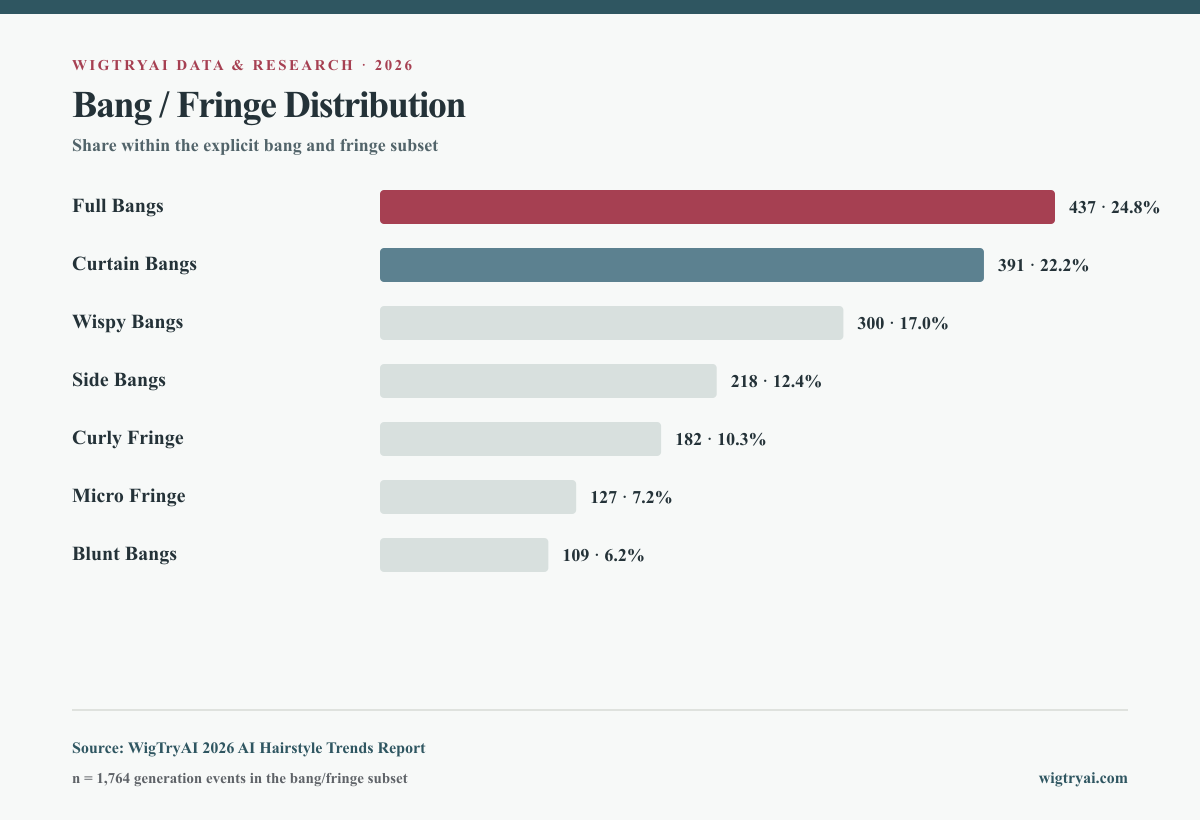
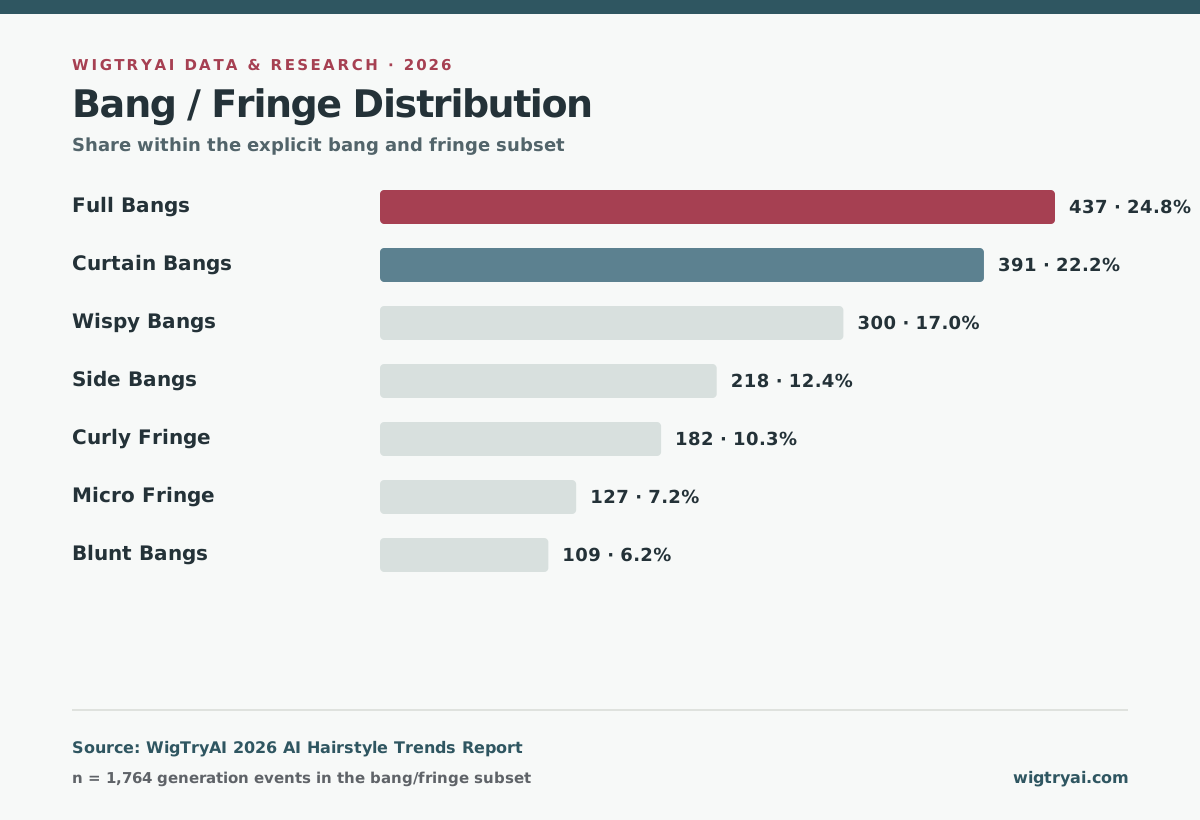
The 2026 AI Hairstyle Trends Report found that styles with an explicit bang or fringe label appeared in 1,764 of 10,000 completed generation events (17.6%). Within that subset, seven styles were recorded:
| Bang style | Generations | Share of bang subset |
|---|---|---|
| Full Bangs | 437 | 24.8% |
| Curtain Bangs | 391 | 22.2% |
| Wispy Bangs | 300 | 17.0% |
| Side Bangs | 218 | 12.4% |
| Curly Fringe | 182 | 10.3% |
| Micro Fringe | 127 | 7.2% |
| Blunt Bangs | 109 | 6.2% |
Do not compare these percentages against 10,000. The denominator for every row is the 1,764-event subset. Full bangs at 24.8% of the subset equals about 4.4% of all generation events.
The Top Three Are the Softest Three
The ranking is not a contest between boldness and safety — the three leaders are the three styles that change the face the most gently:
- Full bangs (24.8%) cover most of the forehead while keeping a single clean shape — a statement that still reads as "hair."
- Curtain bangs (22.2%) part in the middle and frame the face — the least cutting of the three, and barely behind the leader.
- Wispy bangs (17.0%) are barely a bang at all — soft, see-through, and forgiving.
Meanwhile the styles with the sharpest, most permanent geometry — blunt, straight-across bangs (6.2%) and micro fringe (7.2%) — sit at the bottom. Curly fringe (10.3%) and side bangs (12.4%) fill the middle.
Why Curtain Bangs Did Not Win
A common assumption is that curtain bangs are the "trend" of the moment and full bangs are the "before." The data says the opposite in this dataset: full bangs beat curtain bangs by 46 events (437 vs. 391). The gap is small, and the story is still about the three leaders together — 1,128 events, or 63.9% of the fringe subset. Nobody swept the category; the fringe trend was collectively soft.
What the Subset Cannot Tell You
The bang analysis uses the subset of generations with an explicit bang or fringe label. A person might generate a bob with a fringe, a long style with wispy bangs, or a curly cut with side bangs — the subset does not link fringe styles to base styles. The dataset also does not include photos or self-reported reasons, so the "soft wins" reading is an interpretation of the distribution, not a measured motive. See limitations in the source report.