WigTryAI

2026-07-22

We Analyzed 10,000 AI Hairstyle Generations: Which Hairstyles Do People Try Most?

An analysis of 10,000 WigTryAI hairstyle generation events reveals the most popular styles, lengths, colors, and types of bangs.

Hair trendsAI hairstylesData insights

WigTryAI Hair Trends & Insights — 2026

Data note: This report analyzes 10,000 completed AI hairstyle generations on WigTryAI.[^data] All figures are reported in aggregate. One generation represents one completed hairstyle try-on—not one unique person—and a single user may generate multiple looks. The report does not analyze or publish uploaded photos, identify individual users, or infer demographic characteristics from images.

Most hair trend coverage focuses on what stylists predict, what editors feature, or what people search for.

AI try-on data captures a different point in the decision process:

Which hairstyles do people actually want to see on themselves?

That distinction matters. Searching for a butterfly cut, saving a photo of a bob, and generating that look on your own face reflect three very different levels of interest.

This report examines 10,000 WigTryAI generations across 29 individual hairstyles, seven style families, five length ranges, eight broad color categories, and seven specific types of bangs or fringe.

The results reveal clear favorites—but no single hairstyle dominates.

Key findings

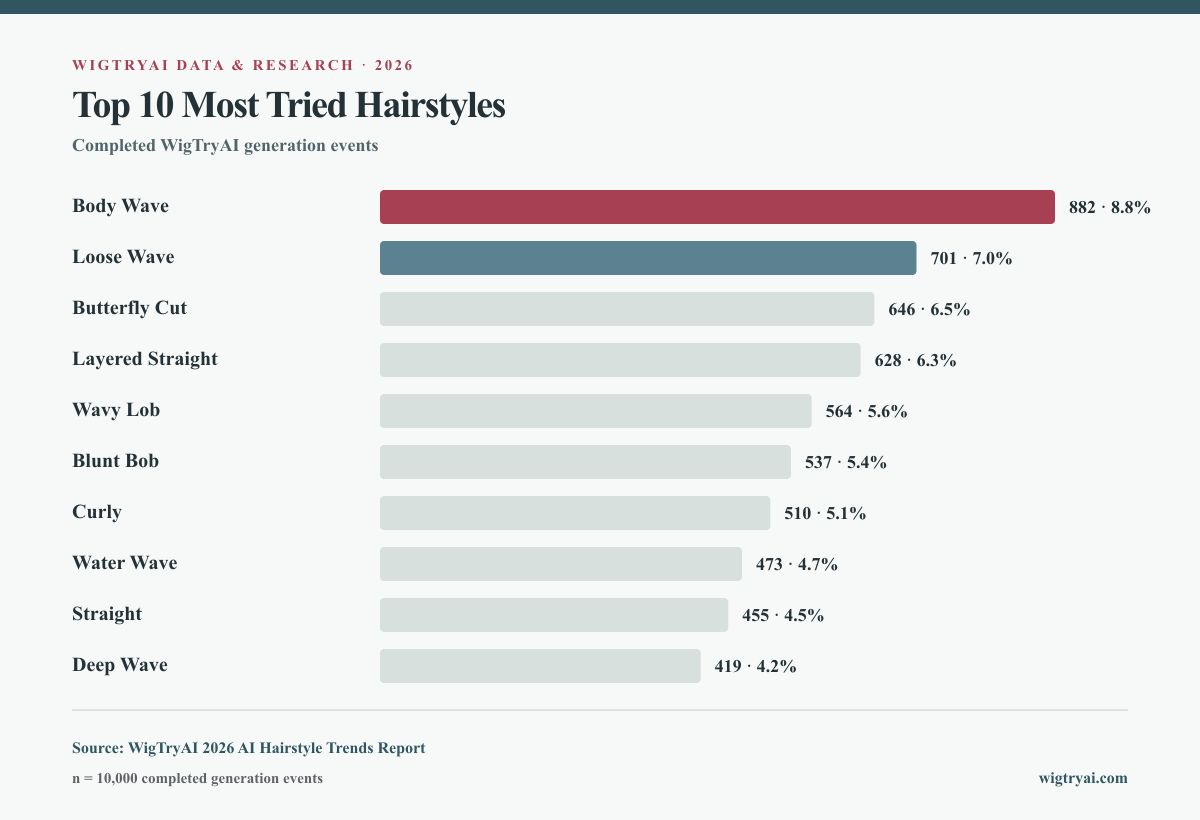
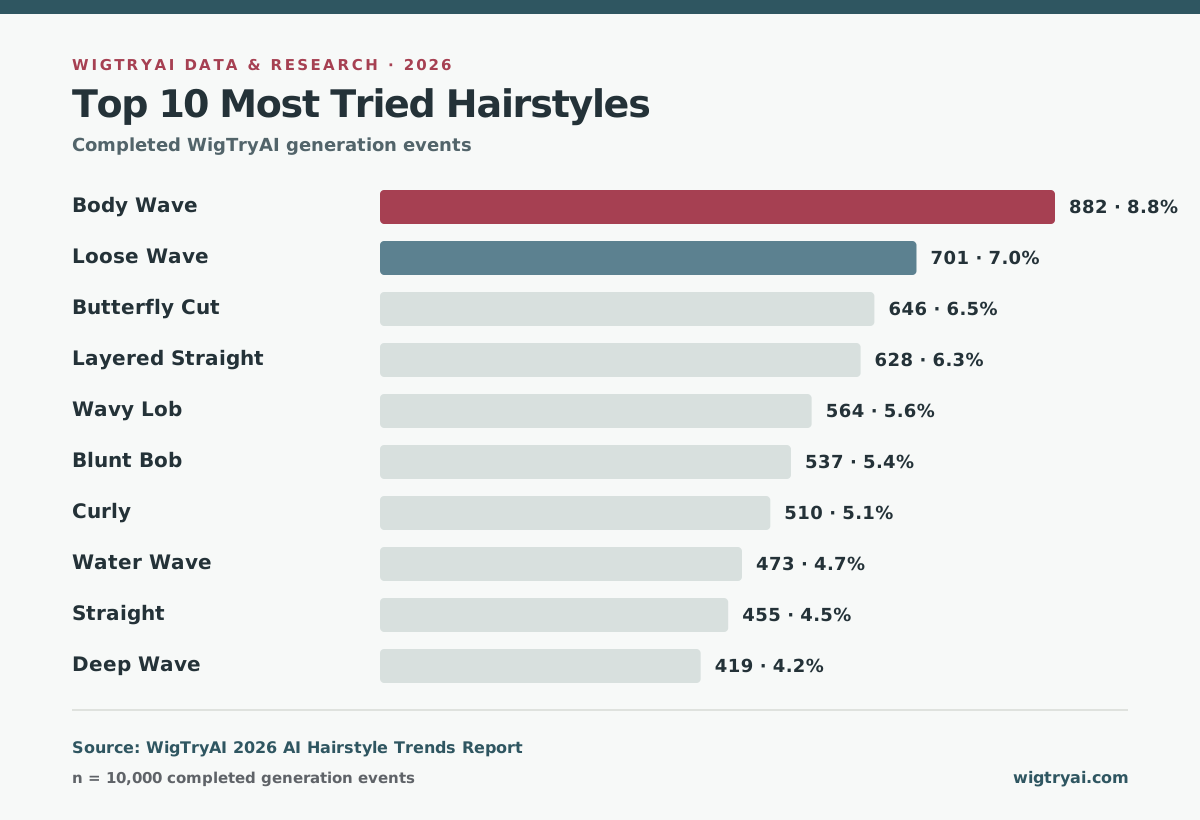
Bar chart showing the ten most frequently generated WigTryAI hairstyles, led by Body Wave

Figure 1. The ten most frequently generated hairstyles in the 10,000-generation dataset. Source: WigTryAI aggregate generation data.

Why AI try-on behavior is a meaningful trend signal

Hair is deeply connected to identity and self-expression. A 2026 qualitative study published in Body Image found that positive relationships with hair were associated with personal choice, authentic self-expression, and a sense that one’s appearance reflected one’s identity.[^1]

That helps explain why hairstyle choices are so personal—and why a general trend list can only tell part of the story.

Someone may love the look of a very short pixie without ever planning to cut their own hair that short. Someone else may keep considering bangs but still wonder how fringe would change the balance of their face.

Virtual try-on sits between inspiration and commitment. It helps people move from “I like this hairstyle” to “I want to see what it looks like on me.”

Research on beauty-focused augmented reality has found that usefulness, visual appeal, and the overall experience can shape satisfaction with AR beauty tools.[^2] Separate research on virtual try-on found that greater cognitive involvement can make people feel more certain about their opinions, while privacy concerns may weaken that effect.[^3]

These studies cannot explain why any individual WigTryAI generation occurred. They do, however, support a broader point: actively trying a look is meaningfully different from passively browsing one.

Methodology

The analysis is based on a snapshot of 10,000 completed WigTryAI hairstyle generations.[^data]

Unit of analysis

Each record represents one completed generation event.

It does not represent:

A single user may generate multiple looks while comparing hairstyles, lengths, colors, or fringe options.

Dimensions analyzed

The aggregate dataset was analyzed by:

  1. named hairstyle;
  2. style family;
  3. hair length;
  4. broad hair color category;
  5. explicit bang or fringe style.

Percentages for hairstyles, style families, lengths, and colors are calculated using all 10,000 generations.

Percentages for bang styles are calculated using the 1,764-generation bang/fringe subset.

Privacy and scope

The report relies only on aggregate selection counts. It does not involve publishing photos, reviewing individual faces, or building demographic profiles from uploaded images.

How to interpret the results

These results describe activity within WigTryAI’s available hairstyle library. They should not be treated as a population-wide survey.

The available options, how they are named and positioned in the interface, repeat generations, and the mix of visitors to WigTryAI can all influence the results.

1. Body Wave leads the individual hairstyle ranking

Body Wave ranked first with 882 generations, representing 8.8% of the dataset.

Loose Wave came second with 701 generations, followed by Butterfly Cut and Layered Straight in third and fourth place.

Rank Hairstyle Generations Share
1 Body Wave 882 8.8%
2 Loose Wave 701 7.0%
3 Butterfly Cut 646 6.5%
4 Layered Straight 628 6.3%
5 Wavy Lob 564 5.6%
6 Blunt Bob 537 5.4%
7 Curly 510 5.1%
8 Water Wave 473 4.7%
9 Straight 455 4.6%
10 Deep Wave 419 4.2%

Together, the top three styles accounted for 2,229 try-ons (22.3%).

The top ten accounted for 5,815 try-ons (58.2%).

Still, no individual style reached 10%. That is one of the report’s clearest findings: hairstyle exploration is concentrated enough to reveal patterns, but varied enough to remain highly personal.

Why wave styles stand out

Four named wave textures appear in the top ten: Body Wave, Loose Wave, Water Wave, and Deep Wave. Wavy Lob adds another wave-based silhouette.

Wave styles create a noticeable change in texture and volume without the dramatic face exposure of a pixie or very short bob.

They also cover a wide visual range, from soft movement to more defined texture. In other words, “wave” is not a single interchangeable look.

2. Waves and bobs make up nearly half of all generations

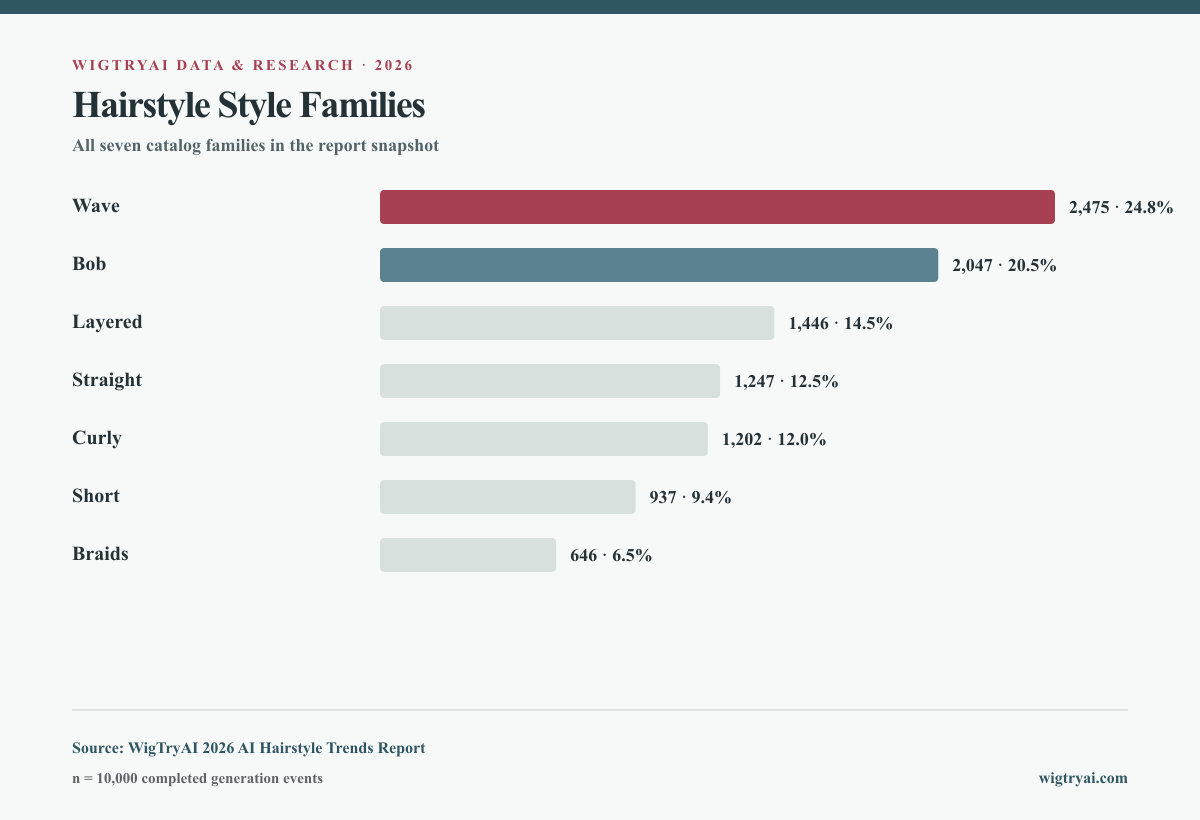
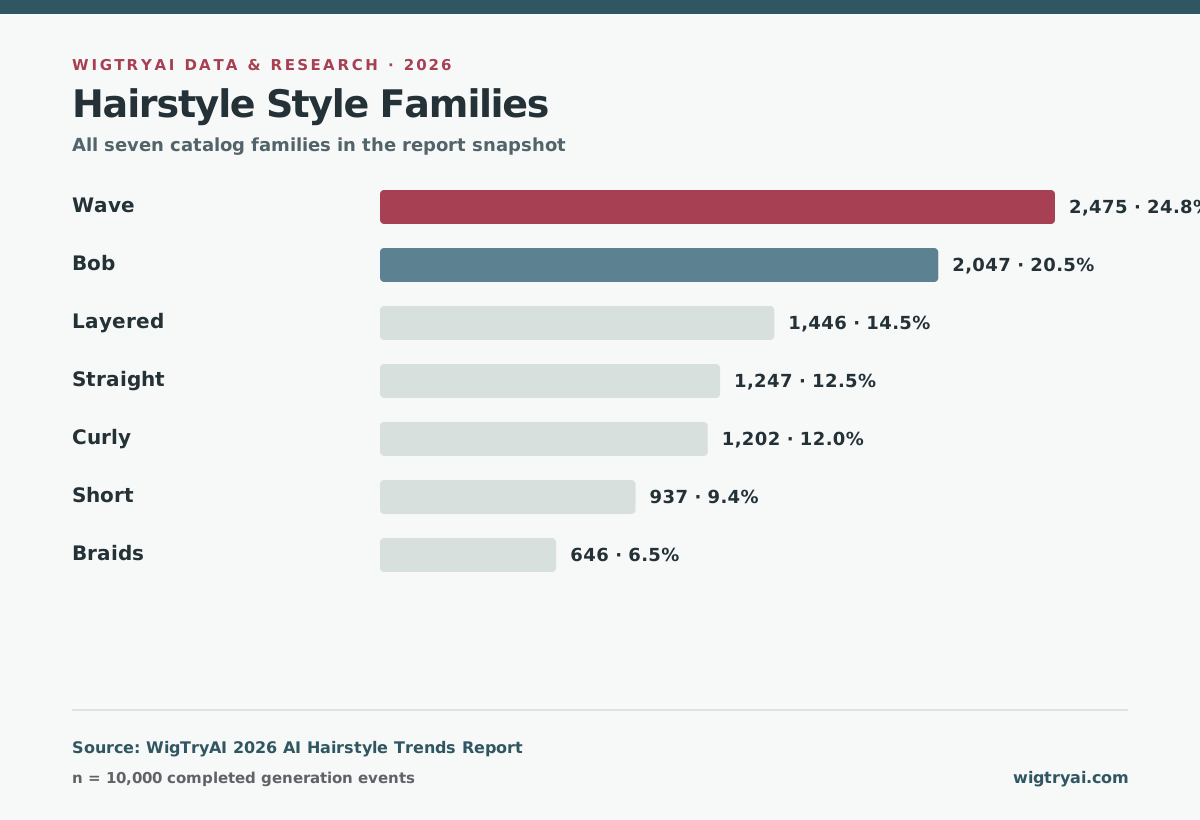
Bar chart of WigTryAI hairstyle generation events by style family, with Wave and Bob leading

Figure 2. Aggregate generations grouped by style family. Source: WigTryAI aggregate generation data.

Style family Generations Share
Wave 2,475 24.8%
Bob 2,047 20.5%
Layered 1,446 14.5%
Straight 1,247 12.5%
Curly 1,202 12.0%
Short 937 9.4%
Braids 646 6.5%

Wave was the leading family, but Bob trailed by only 428 generations.

Combined, the two families accounted for 4,522 generations (45.2%).

Adding the Layered family brings the top three families to 59.7% of the full dataset.

These family totals still need context. A category with more available variations has more opportunities to accumulate generations, so the results reflect both user activity and the structure of WigTryAI’s hairstyle library.

3. Bobs are the leading high-change category

No individual bob ranked first overall, but the Bob family still accounted for 20.5% of all generations.

The family includes several distinct silhouettes:

Bob style Generations Share of all generations
Wavy Lob 564 5.6%
Blunt Bob 537 5.4%
Curly Bob 373 3.7%
French Bob + Full Bangs 273 2.7%
Asymmetrical Bob 173 1.7%
Micro Fringe Bob 127 1.3%

This range shows why “the bob” should not be treated as a single look.

A wavy lob preserves more length and softness. A blunt bob creates a sharper, cleaner line. A French bob with full bangs changes both length and forehead framing, while a curly bob changes texture, width, and overall silhouette at the same time.

That variety makes bobs especially useful for visual comparison.

The WigTryAI results also align with broader 2026 editorial coverage. Vogue highlighted the graduated bob in its 2026 trend forecast.[^4] Allure’s summer 2026 report featured the Hollywood bob and collarbone lob,[^6] while ELLE described fragmented bobs as one of the season’s strongest haircut trends.[^7]

Editorial coverage does not explain the WigTryAI counts. Still, the overlap between observed try-on behavior and current beauty reporting makes the category worth watching.

4. Long hair leads—but extra-long hair does not

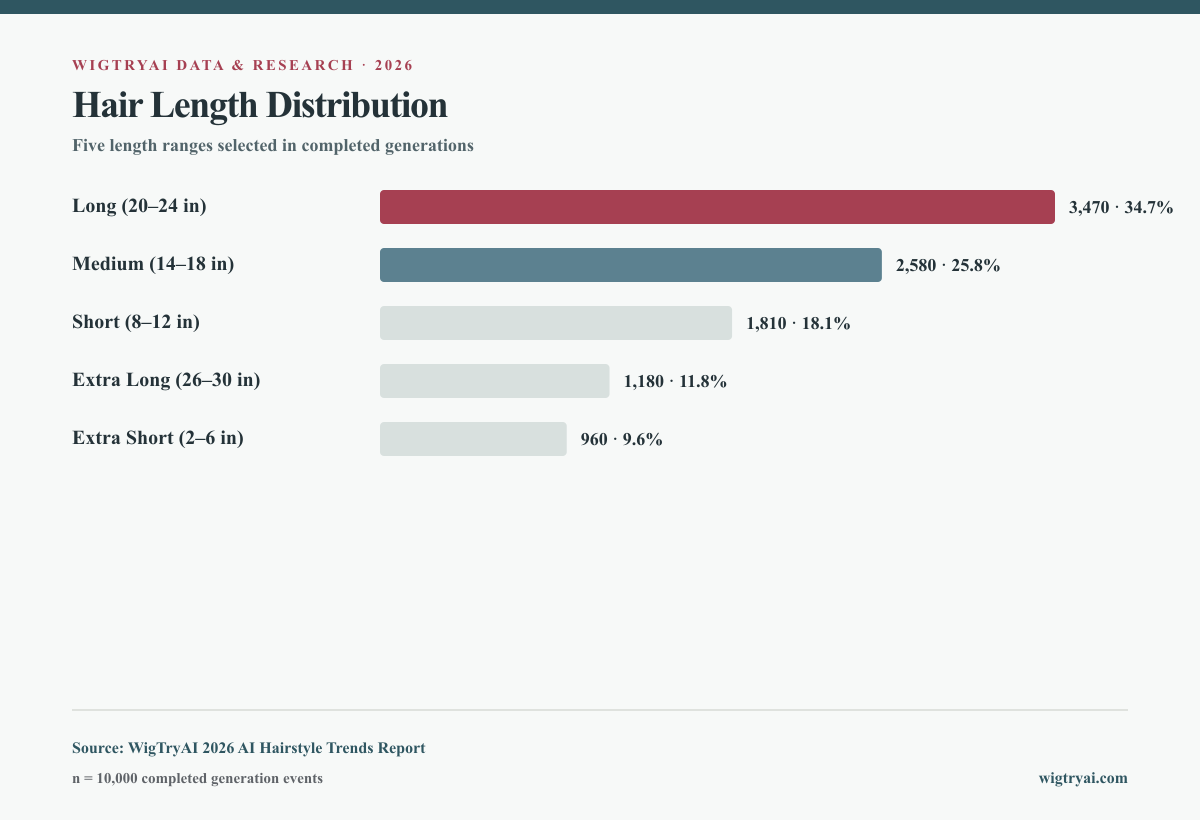
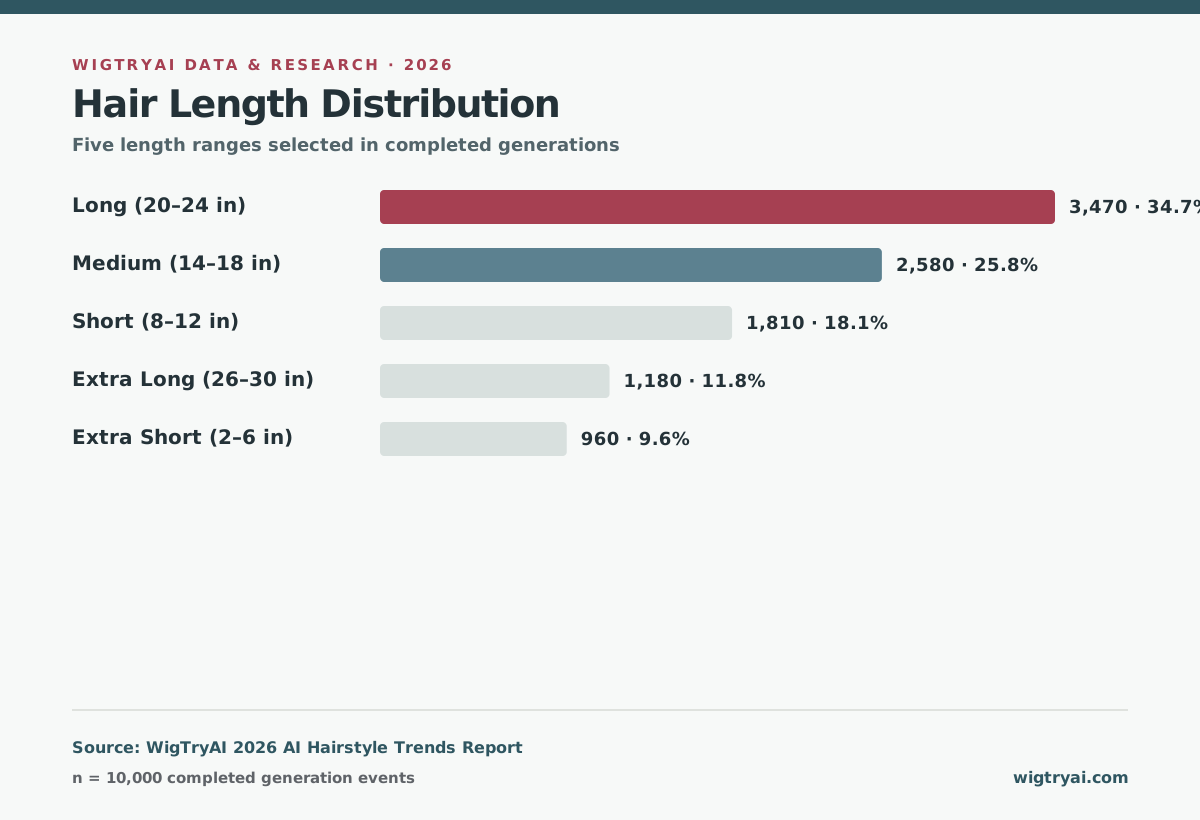
Bar chart of WigTryAI hairstyle generation events by hair length, led by 20-to-24-inch long hair

Figure 3. Generations across the five WigTryAI length bands. Source: WigTryAI aggregate generation data.

Length Generations Share
Long (20–24 in) 3,470 34.7%
Medium (14–18 in) 2,580 25.8%
Short (8–12 in) 1,810 18.1%
Extra Long (26–30 in) 1,180 11.8%
Extra Short (2–6 in) 960 9.6%

The most popular length range was Long (20–24 inches), not Extra Long.

Medium and Long together accounted for 6,050 generations (60.5%).

Short and Extra Short together accounted for 2,770 generations (27.7%), showing that shorter silhouettes still drew substantial interest even though longer looks led overall.

That makes the picture more nuanced than simply saying “long hair wins.”

Most activity clustered in a versatile medium-to-long range, while shorter styles remained important because they create a more dramatic transformation.

Current editorial coverage reflects the same range. Allure’s summer 2026 trend report includes Hollywood bobs and bixies alongside quiet-luxury layers and extra-long hair with bangs.[^6] Vogue has also described 2026 as a year defined by more movement, texture, and individuality in hair.[^5]

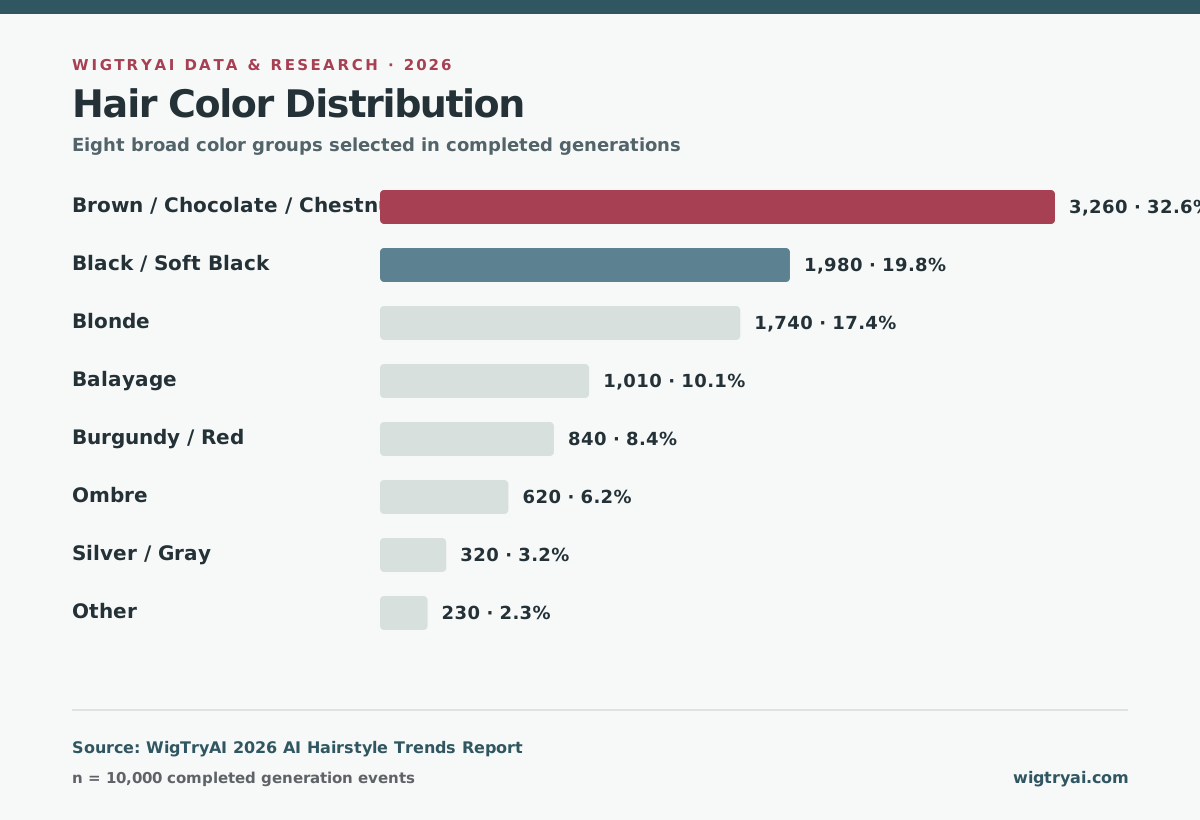
5. Rich brunette shades lead color exploration

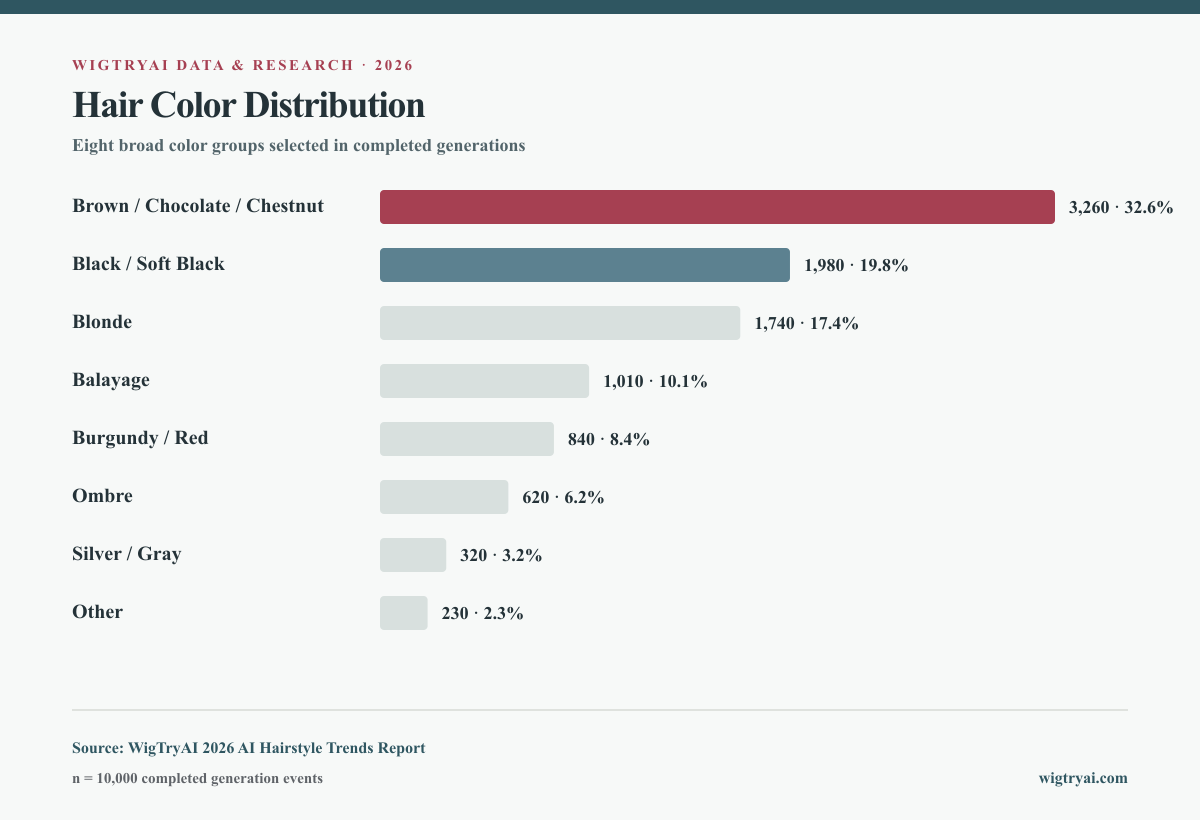
Bar chart of hair color categories selected in WigTryAI generation events, led by brown, chocolate, and chestnut

Figure 4. Broad color categories selected across the 10,000 generations. Source: WigTryAI aggregate generation data.

Color category Generations Share
Brown / Chocolate / Chestnut 3,260 32.6%
Black / Soft Black 1,980 19.8%
Blonde 1,740 17.4%
Balayage 1,010 10.1%
Burgundy / Red 840 8.4%
Ombre 620 6.2%
Silver / Gray 320 3.2%
Other 230 2.3%

Brown, chocolate, and chestnut shades appeared in nearly one-third of all try-ons.

When combined with Black and Soft Black, darker, natural-looking color categories accounted for 5,240 generations (52.4%).

Blonde still represented a major transformation category at 17.4%.

Balayage and ombré together reached 16.3%, suggesting strong interest in dimensional color changes rather than single-tone replacements alone.

The brunette lead also aligns with Vogue’s 2026 forecast, which highlighted rich mocha, coffee, and espresso-inspired shades.[^4] This is an overlap between two different signals—not evidence that editorial coverage caused the observed behavior.

6. Bangs appear in nearly one in six generations

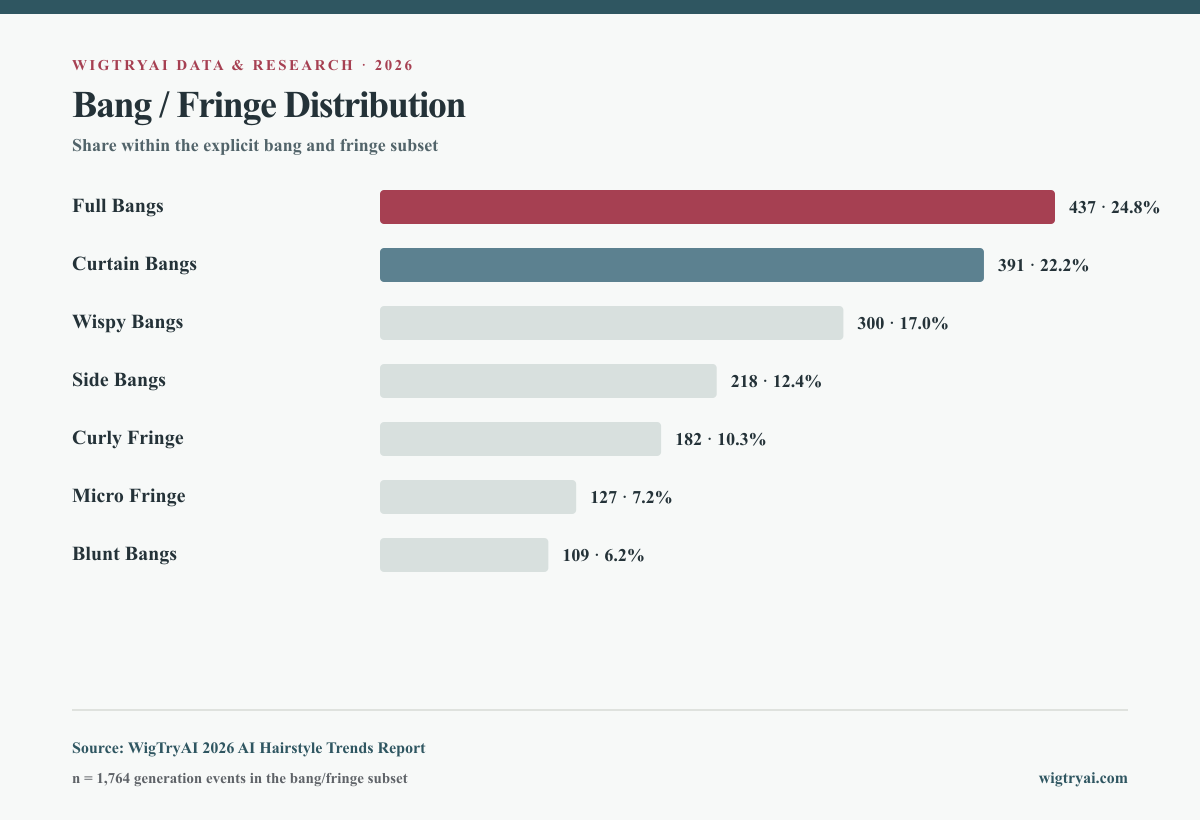
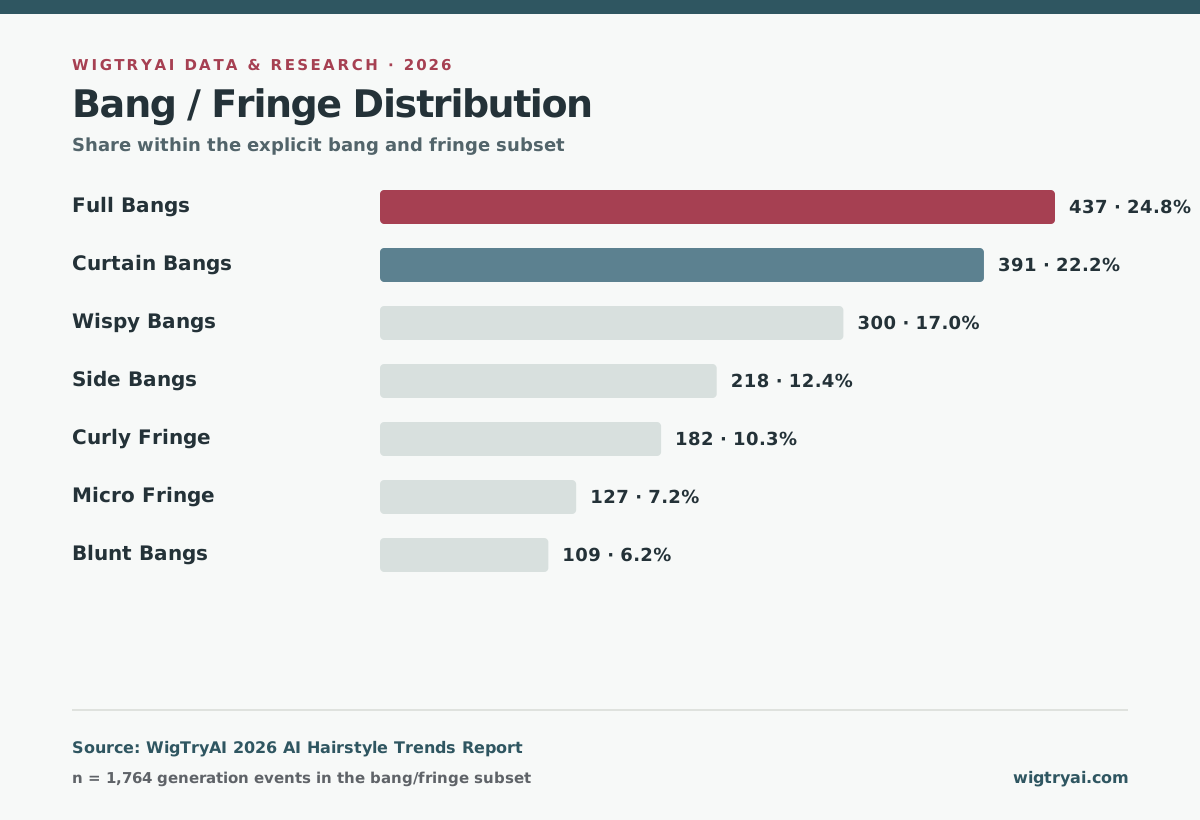
Hairstyles explicitly labeled with bangs or fringe appeared in 1,764 generations (17.6%).

Bar chart of bang and fringe styles within the 1,764 WigTryAI generation event subset

Figure 5. Distribution within the 1,764-generation bang/fringe subset. Percentages in this chart use the subset—not the full 10,000 generations—as the denominator.

Bang style Generations Share of bang subset
Full Bangs 437 24.8%
Curtain Bangs 391 22.2%
Wispy Bangs 300 17.0%
Side Bangs 218 12.4%
Curly Fringe 182 10.3%
Micro Fringe 127 7.2%
Blunt Bangs 109 6.2%

Full Bangs was the most common style within the subset, followed by Curtain Bangs and Wispy Bangs.

Together, those three styles accounted for 1,128 fringe generations (64.0% of the subset).

Bangs can dramatically change a look because they instantly affect forehead coverage and face framing. They are also difficult to judge from a hairstyle name alone.

Allure’s 2026 fringe coverage highlights curly fringe, curtain bangs, wispy bangs, and micro bangs among the year’s prominent styles.[^8] Vogue also includes side fringe and disconnected bangs in its 2026 forecast.[^4]

These editorial sources provide context only. The percentages in this report come from WigTryAI’s aggregate generation data.

7. The top styles point to three types of experimentation

The dataset shows what users generated, not why they generated it. User intent was not surveyed.

Even so, the patterns suggest three useful behavioral interpretations.

Familiar transformations

This group includes Body Wave, Loose Wave, Layered Straight, Butterfly Cut, and rich brunette colors.

These looks create a noticeable change while staying within familiar, widely recognized beauty styles.

Structural changes

This group includes Wavy Lob, Blunt Bob, Curly Bob, Pixie Cut, and Bixie + Side Bangs.

These styles change the overall hair silhouette and how much of the face and neck is exposed. They can answer an important visual question before someone commits to a major cut.

Curiosity-driven experimentation

This group includes Full Bangs, Micro Fringe, Hime Cut, Jellyfish + Blunt Bangs, Modern Mullet, and stronger color changes.

Generating a style does not mean someone plans to adopt it. The look may simply have been interesting enough to preview.

That is one of the strengths of try-on data: it can capture curiosity that may never show up in salon bookings or final hairstyle choices.

8. Where WigTryAI behavior aligns with 2026 trend coverage

Trend direction Observed WigTryAI signal External 2026 signal Reading
Waves and movement Wave family ranks #1 at 24.8% Vogue highlights movement, texture, and expressive hair Strong alignment
Bob and lob styles Bob family ranks #2 at 20.5% Vogue, Allure, and ELLE give bobs extensive coverage Strong alignment
Layered silhouettes Layered family reaches 14.5%; Butterfly Cut ranks #3 Editorial coverage emphasizes movement and soft layering Alignment
Bangs and fringe Explicit fringe appears in 17.6% of generations Vogue and Allure highlight multiple fringe directions Alignment
Rich brunette Brown/chocolate/chestnut leads at 32.6% Vogue highlights mocha and espresso brunette Strong alignment
Pixie and bixie Combined 445 generations (4.5%) Short cuts receive prominent editorial attention Media visibility exceeds site share
Braids 646 generations (6.5%) Less dominant in mainstream 2026 trend roundups Meaningful site activity despite lower editorial visibility

This comparison is not causal.

People may be influenced by editorial coverage, social media, stylists, personal preferences, the WigTryAI interface, or several factors at once.

The clearest takeaway is that several of the strongest try-on categories also receive substantial attention in current hair reporting.

9. What the data can—and cannot—tell us

The data can show

The data cannot show

These figures should also not be used to claim that a style is universally flattering or right for a particular person.

AI previews are visual references, not guarantees. Real-world results can vary because of natural texture, density, shrinkage, hair condition, styling technique, lighting, and the limitations of image generation.

10. What WigTryAI should analyze next

This first report provides a clear aggregate baseline.

Future reports could explore more specific behavioral questions without analyzing personal traits from photos:

  1. Which styles are most often compared within the same session?
  2. Which hairstyle is most likely to be followed by a color change?
  3. Do users explore short cuts before returning to longer styles?
  4. Which styles receive the highest repeat-generation rate?
  5. How do style selections differ by landing page or traffic source?
  6. Which trends grow or decline month by month?
  7. Which options are frequently generated together in comparison images?

Tracking these patterns over time would be especially useful, because it could help distinguish stable preferences from short-lived trend spikes.

Conclusion

The clearest takeaway from 10,000 WigTryAI generations is not that one hairstyle won.

It is that people explore hairstyles through a mix of familiarity, transformation, and curiosity.

Body Wave ranks first, but it represents only 8.8% of all generations. Wave and Bob are the two largest style families, yet Layered, Straight, Curly, Short, and Braided looks still account for more than half of all activity combined.

Long hair is the leading length, but shorter cuts still draw substantial interest. Rich brunette shades lead the color categories, while blonde, balayage, ombré, and red all maintain meaningful shares. Bangs appear often enough to be a major preview category, but no single fringe style dominates the segment.

For hairstyle discovery, that variety is the story.

People are not looking for one universally “correct” hairstyle. They are using AI to answer a much more personal question:

What would this look like on me?

To compare a few directions on the same photo, try hairstyles on your photo with WigTryAI and treat the result as a visual reference—not a guarantee of a salon result.


Methodology appendix

Full hairstyle dataset

Hairstyle Generations Share
Body Wave 882 8.82%
Loose Wave 701 7.01%
Butterfly Cut 646 6.46%
Layered Straight 628 6.28%
Wavy Lob 564 5.64%
Blunt Bob 537 5.37%
Curly 510 5.10%
Water Wave 473 4.73%
Straight 455 4.55%
Deep Wave 419 4.19%
Long Shag + Curtain Bangs 391 3.91%
Curly Bob 373 3.73%
Box Braids 337 3.37%
Goddess Braids 309 3.09%
Wolf Cut + Wispy Bangs 300 3.00%
French Bob + Full Bangs 273 2.73%
Kinky Curly 264 2.64%
Afro Curly 246 2.46%
Pixie Cut 227 2.27%
Bixie + Side Bangs 218 2.18%
Short Shag 191 1.91%
Curly Shag + Bangs 182 1.82%
Asymmetrical Bob 173 1.73%
Hime Cut + Full Bangs 164 1.64%
Modern Mullet 146 1.46%
Micro Fringe Bob 127 1.27%
Jellyfish + Blunt Bangs 109 1.09%
Bowl Cut 82 0.82%
Buzz Cut 73 0.73%

Reuse and citation guidance

Charts and aggregate figures from this report may be reused with attribution to WigTryAI and a link to the published report.

Suggested citation:

WigTryAI Data & Insights. (2026). We Analyzed 10,000 AI Hairstyle Generations: Which Hairstyles Do People Try Most?

When citing the data, describe it as 10,000 hairstyle generation events, not 10,000 unique users.


Sources

[^data]: WigTryAI aggregate hairstyle generation dataset used for this report, n = 10,000 generation events. Internal aggregate analysis, July 2026.

[^1]: Anastasiades, E., Todd, J., Kirk, E., & Swami, V. (2026). “I don’t care what you like, when I look in the mirror, I need to be happy”: A qualitative study of hair-related positive body image. Body Image. https://doi.org/10.1016/j.bodyim.2026.102136

[^2]: Laberger, M., Tartarin, A., & Lee, S. K. (2026). Exploring consumer satisfaction with an AR beauty app based on the technology acceptance model and experience economy theory. Journal of Marketing Analytics, 14(1), 308–325. https://doi.org/10.1057/s41270-024-00360-9

[^3]: Lavoye, V., et al. (2025). Understanding how augmented reality's immersive experience and privacy concerns impact consumer responses: A cognitive perspective. Journal of Retailing and Consumer Services, 87, 104425. https://doi.org/10.1016/j.jretconser.2025.104425

[^4]: Vogue. (2025). 11 Hair Trends You're About to See Everywhere in 2026. https://www.vogue.com/article/11-hair-trends-2026

[^5]: Vogue. (2026). I'm Calling It: 2026 Brings Hair That Moves. https://www.vogue.com/article/im-calling-it-2026-brings-hair-that-moves

[^6]: Allure. (2026). This Summer's Haircut Trends Are Major Throwbacks. https://www.allure.com/story/summer-haircut-trends-2026

[^7]: ELLE. (2026). From the Butterfly Bob to the Curved Cut, 5 New Bob Haircuts That Are Trending for Summer. https://www.elle.com/beauty/hair/a71411938/bob-hairstyles-summer-2026-trends/

[^8]: Allure. (2026). Bangs Are Getting Bolder in 2026. https://www.allure.com/story/bangs-trends-2026

Try hairstyles on your photo