
Before the appointment
What to Expect at a Hair Consultation: The Invisible Half Starts Before You Sit Down
The conversation in the chair is the second half of a consultation. The first half happens in the days before, when you look at styles and decide which questions you are actually asking. The data says most of those questions are about shape — and shape is the part you can prepare.
Hair consultationHair appointment prepAI hairstyle try-on
5 min read
Quick answer
The short answer
A consultation is a conversation that ends with a plan: what will change, how long it will take, and what it will take to maintain. The useful preparation happens before the appointment — arriving with two or three directions previewed on your own photo, one thing you refuse to lose, and an honest account of your morning routine. The data from 10,000 completed try-ons shows that what people explore first is shape: waves and bobs together made up 45.2% of recorded activity, while extreme colors stayed rare.
- Bring
- Two or three previews, same photo
- Name
- The one variable you changed
- Do not skip
- Your hair history and your non-negotiables
You sit down. The stylist asks what you want, and you say the sentence that starts a hundred disappointing appointments: something different, but not too different.
That answer is not a failure of taste. It is a missing reference. The version of the conversation that goes well usually begins a few days earlier, when you look at styles, preview two or three of them on your own photo, and figure out which question you are actually asking. By the time you sit down, half the consultation is already done.
The Appointment Is the Second Half
A hair consultation has three phases, and only one of them happens in the salon.
- Before: you explore directions, preview them on your photo, and narrow to two or three candidates.
- During: you and your stylist agree on what changes, what stays, and how the shape grows out.
- After: you maintain the cut — or you spend the next few months growing it out.
The before phase is invisible in the sense that nobody books it, and it is the phase that decides how useful the appointment is. It is also the only phase with public data behind it: WigTryAI's 2026 AI Hairstyle Trends Report analyzes 10,000 completed generation events — recorded explore-and-preview activity, not appointment records. The dataset cannot tell you how many people booked anything. It can tell you what people were looking at while they made up their minds.
One note on how to read that framing: the three-phase shape is how this page organizes the process, not a measured fact. Nothing in the dataset records where a preview sat in someone's week, or whether an appointment followed it.
What People Explore Before They Sit Down
The dataset cannot place a preview on a timeline, but it can show what dominated the exploration — and it shows shape, with restraint.
| What was explored | Share of 10,000 generation events |
|---|---|
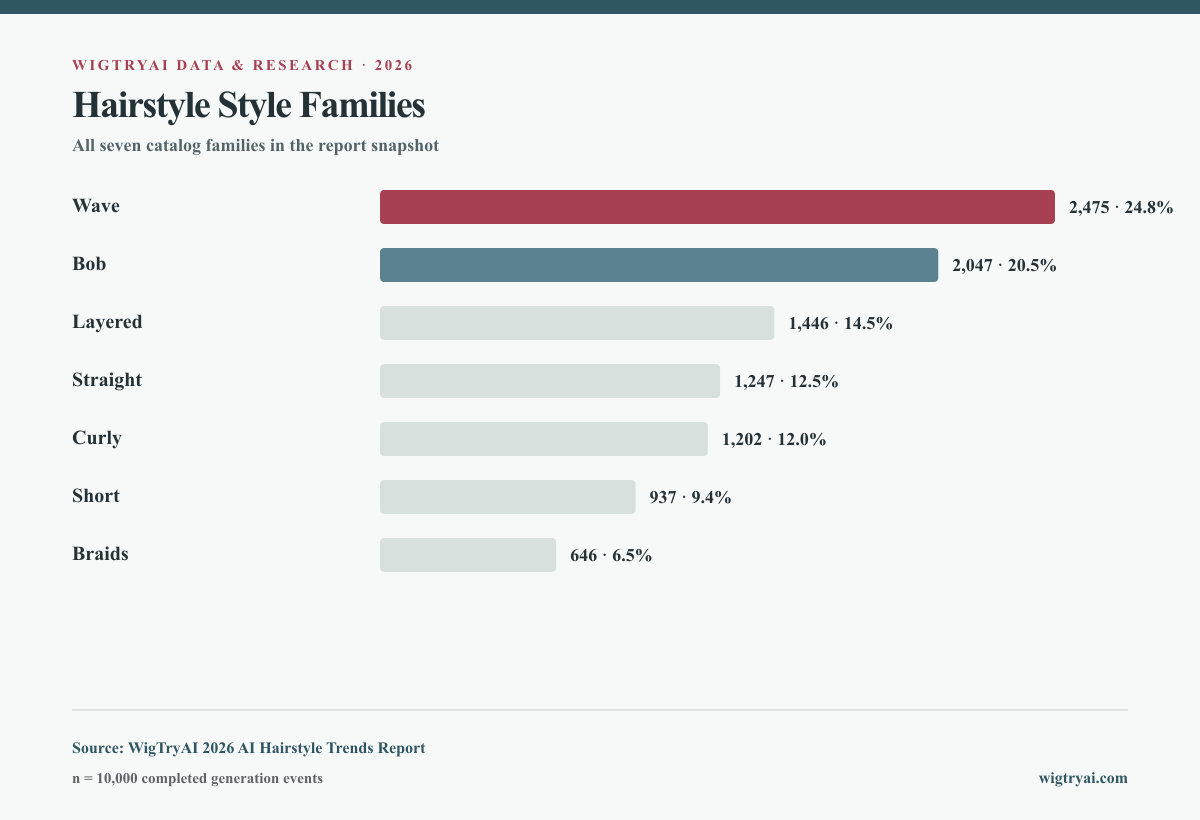
| Wave family (Body, Loose, Deep, Water) | 24.8% |
| Bob family | 20.5% |
| Long hair, 20–24 inches | 34.7% |
| Brown, chocolate, or chestnut color | 32.6% |
| Silver or gray color | 3.2% |
| Ombre | 6.2% |
Two families of silhouette — waves and bobs — accounted for 45.2% of everything generated, and the length dimension leaned toward hair that already reads as "long" rather than dramatic. The fringe subset tells the same story from another angle: within 1,764 generations that included a fringe, Full Bangs (24.8%), Curtain Bangs (22.2%), and Wispy Bangs (17.0%) led, while Blunt Bangs came last at 6.2%.
Read that as a description of the questions people were exploring. They are mostly about shape: more texture, a shorter outline, a fringe that frames the face. The dramatic color change you might expect to dominate a preview tool — silver, ombre, a full transformation — is the rare case, not the norm.
That is good news for your appointment. Shape is the part a stylist can plan with you in the chair. Color history is the part that needs facts.
What Your Stylist Is Actually Checking
The questions sound casual. Each one is gathering something specific, and a prepared answer saves a round trip.
Decision guide
The four questions behind the small talk
Answer these before you are asked, and the consultation moves to the plan faster.
| Your stylist asks | What they are checking | What to bring |
|---|---|---|
| How much do you want off? | Where the ends will sit, and how the shape grows out from there | Two previews of the same photo with different endpoints, such as chin length versus collarbone |
| How much time do you have in the morning? | The styling the finished cut needs on a normal weekday | A realistic number of minutes, plus the tools you actually use |
| What is your hair history? | Chemical treatments, previous color, heat damage, and how your hair behaved last time | Dates of your last color, bleach, or straightening service, and any home color you have used |
| What do you want to keep? | Your non-negotiables — length you can tie back, a parting, a fringe you refuse to grow out | One sentence naming the thing you do not want to lose |
Notice what is missing from that list: the name of a hairstyle. Stylists can build a butterfly cut or a bixie from a photo, but the decisions that make it work — endpoint, texture, upkeep, history — are the ones that need your input.
Two Preview Images Beat Twelve Screenshots
A folder of inspiration photos answers the wrong question. The person in the photo has different density, a different face shape, and a different starting length, so the stylist has to translate before they can advise.
A preview on your own photo removes the translation step — but only if you control the comparison. Generate two versions where exactly one thing changed, then say which one it is out loud:
"This is me with the ends at my chin, and this is me with the ends at my collarbone. Everything else is the same."
That sentence gives a stylist something to answer, and it usually produces the most useful question in the appointment: which of these can you actually maintain?
If you want the full workflow — naming the question, building a shortlist, reviewing previews in a fixed order — it is laid out step by step in how to try hairstyles online. For the appointment itself, three previews are plenty: a shorter version, a longer version, and one different texture. Preview them on one photo with the same color, using the same try-on flow you would use for any comparison, and resist rebuilding the set the night before.
Where the Preview Stops and the Stylist Starts
A preview changes hair in an image. It cannot tell you:
- How your hair behaves at that length. Density, growth patterns, and cowlicks decide whether a shape falls the way the picture does.
- How much styling the shape needs. A photo shows the finished result, not the ten minutes of work behind it.
- What your hair has been through. Previous color, bleach, and heat change what is possible in one appointment.
- How it grows out. Grow-out is where most regret starts, and it is a conversation about time, not appearance.
That is why the consultation exists. The preview narrows the conversation; the stylist checks the parts a photo cannot show, then tells you what the plan will take.
If you are the stylist leading this conversation, use our five-step AI hair consultation workflow to turn a visual preference into a feasible service plan.
What This Data Does Not Cover
The numbers above describe exploration inside one product, and it is worth being precise about their limits:
- Generation events are not appointments. The dataset records completed previews, not bookings, cuts, or follow-ups.
- Timing and journey position are not recorded. Nothing in the dataset shows what happened before or after a preview, so "before the appointment" is this page's framing, not a measured finding.
- Catalog structure shapes the counts. Families with more variations accumulate more events.
- Repeat generations are included. One person can generate several looks in a session.
- The snapshot is dated. Version 1.0 was published July 22, 2026, and describes one catalog.
What it does support is a simple claim: the recorded exploration is mostly about shape, and shape is exactly what a preview can show you.
See the data behind the pre-appointment phase
The 2026 AI Hairstyle Trends Report covers all 29 hairstyles, the family, length, color, and fringe dimensions, the methodology, and the aggregate dataset you can download and check.
Open the 2026 AI Hairstyle Trends ReportFAQ
What should I expect at a hair consultation?
Expect a conversation that ends with a plan. Your stylist will look at your hair's current condition, ask about your history and routine, and then talk through what is possible in the time available. You should leave knowing what will change, roughly how long it will take to maintain, and how the shape will grow out. If you leave without those three answers, ask before the first cut.
What should I bring to a hair appointment?
Bring two or three previews of the same photo with one variable changed, an honest number of minutes you spend on your hair on a normal morning, and your hair history — recent color, bleach, straightening, or home treatments. One non-negotiable is also worth naming out loud, such as the length you need to tie back.
Should I bring photos of hairstyles I like?
Photos help, but bring them with a reason. A screenshot shows a shape; it does not show whether that shape works with your density, face shape, or starting length. A preview on your own photo carries the same information with fewer translation steps, and a named difference — "ends here instead of there" — is easier for a stylist to answer than a folder of images.
Can an AI preview replace a consultation?
No. A preview changes hair in an image, and it can be wrong about density, texture behavior, styling effort, and grow-out. It is a comparison tool: it helps you decide which direction to discuss, and it gives the conversation something concrete to start from. The professional assessment of your hair is what turns that direction into a plan.
What if I do not know what I want yet?
Then the useful move is to narrow rather than decide. Explore two or three clearly different directions on one photo — shorter versus longer, soft texture versus sleek — and bring the two that you keep returning to. A consultation can work with "I like these two and I am not sure why" far better than with "surprise me."
How far ahead should I prepare for an appointment?
A few days is enough. Preview two or three directions on one photo, look at them on two different days, and keep the pair you still like the second time. Rebuilding your whole reference set the night before an appointment usually makes the conversation harder, not easier.