

Quick Answer
AI may help a hair salon increase revenue if it improves a measurable step: bringing in a suitable new client, helping an inquiry become a completed appointment, making a service conversation clearer, or supporting an appropriate return visit. Start with the part of your business that is actually losing work. Then compare completed services and their average spend before and after a small test. A generated preview, a click, or even a booking is not revenue by itself.
The useful question is not “Which AI subscription will make us more money?” It is “Where does a potential paid visit stop, and what would change if we helped that person take the next step?” The answer may be a faster response, a clearer service description, a better consultation, or a reminder that fits the client's service history. Some of those improvements need AI; others need your existing software or a simpler process.
This article gives you a way to do the math before adding another tool. For a map of the different tasks AI can perform, read AI for Hair Salons. For a closer look at the path from inquiry to appointment, use the salon bookings guide.
The opening salon photograph is an AI-generated illustration, not a photograph of a participating business or evidence of a revenue result.
Start With Completed Services, Not AI Activity
For a defined period, service revenue = completed service visits × average service ticket. Calculate the average ticket from service revenue divided by completed visits over that same period. Keep the definition consistent: for example, count service charges after discounts, exclude tax and tips, and track retail sales separately. Your own accounting categories may differ; what matters here is that both periods use the same ones.
First visits and repeat visits both contribute to completed visits, but they enter the business differently. A first visit may start with a local search or referral, then an inquiry, an appointment, and finally an attended service. A repeat visit starts with an existing relationship. Counting both as “new bookings” hides whether acquisition or retention changed.
| Revenue input | Count it as | Do not count it as |
|---|---|---|
| First completed visits | A new client's first attended, paid service | Website visits, inquiries, or unconfirmed requests |
| Repeat completed visits | An existing client's attended, paid return service | Reminder sends or future appointments that may change |
| Average service ticket | Service revenue divided by completed visits in the same period | A menu price that nobody paid |
If your calendar has openings but inquiries go unanswered, improving conversion may add visits. If the calendar is full, extra inquiries alone cannot create another staffed hour. You might instead examine service mix, available capacity, or when clients return. Revenue is not profit: extra color work may also add labor time, products, and other costs.
Four Places AI Could Help—and What to Measure
The four levers below are diagnostic categories, not four numbers to multiply together. A salon can improve one while another stays flat. Choose the row that matches the problem you can observe.
| Lever | Possible AI-assisted task | Measure before and after | Check alongside it |
|---|---|---|---|
| New client acquisition | Draft a useful local service explanation from approved salon facts | Qualified new inquiries and first completed visits | Staff capacity and acquisition cost |
| Inquiry to completed appointment | Help answer routine questions or make a look easier to discuss | Correct handoffs, booked appointments, attended first visits | Cancellations and wrong-service bookings |
| Average service ticket | Show two visual directions before a stylist discusses service options | Actual service revenue per completed visit | Service time, material cost, and client consent |
| Repeat visits | Draft a relevant follow-up using a client's agreed service interval | Attended return visits over a defined period | Opt-outs, duplicate reminders, and seasonal changes |
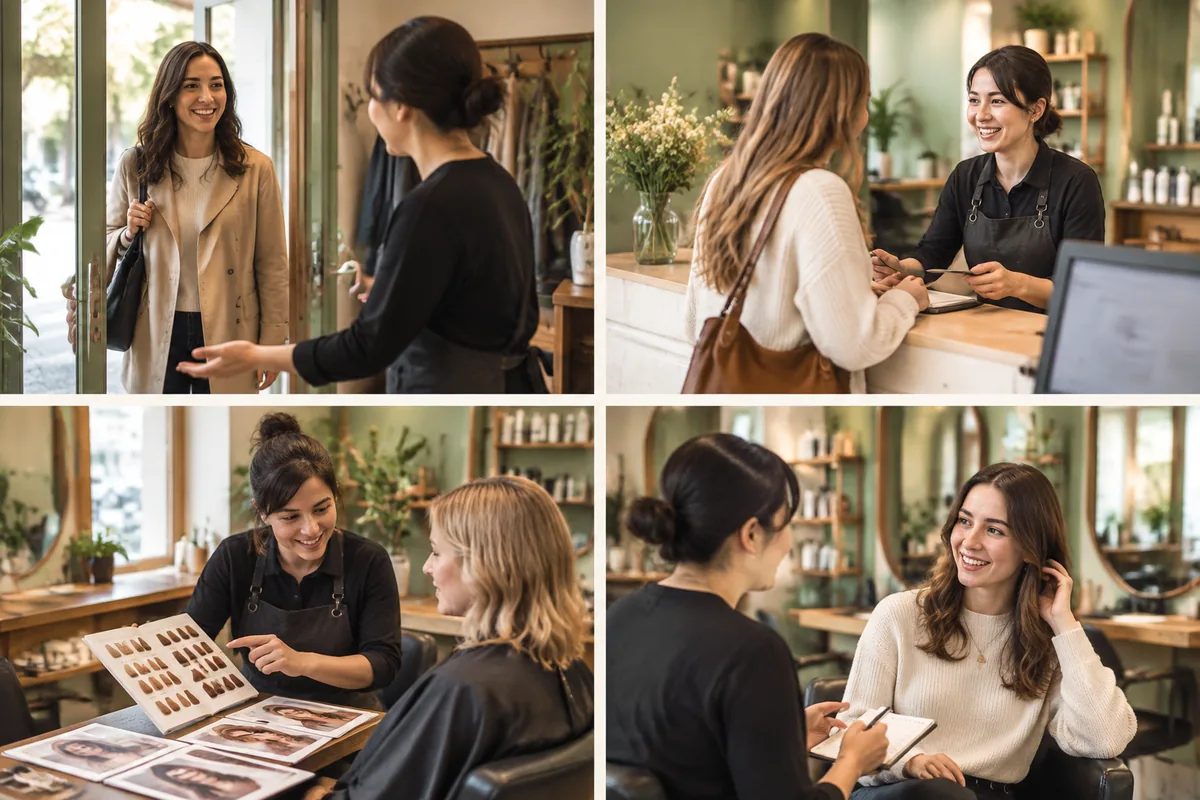
These AI-generated scenes show conversations at the entrance, reception desk, and styling chair. They illustrate moments where a salon might ask a better question; they do not document four measured outcomes.
New clients. A writing assistant can turn a real service question into a page or post: who the service is for, what it involves, and how to ask about it. An accurate page can help a prospective client recognize a fit. Check whether it brings appropriate inquiries and first completed visits; publishing more words is only an activity metric. Keep the salon's actual prices, location, and service rules under human review.
From inquiry to visit. An AI receptionist may answer routine questions if it has accurate business information and a reliable handoff. A visual preview addresses a different obstacle: a client may be interested in a bob or a color change but unable to picture the direction on themselves. Neither a good answer nor an appealing preview guarantees the client books, arrives, or chooses the right service. The booking journey guide covers those intermediate steps in detail.
Average ticket. A visual comparison can create room to discuss a fringe, color service, or treatment that the client did not initially consider. That is an opportunity for an informed discussion, not an automatic upsell. The stylist must decide what is suitable, explain the full price and time, and check that the client wants the added service. Measure the services actually performed and paid for, along with any added cost or time.
Return visits. A follow-up can be more useful when it reflects what happened at the last visit and when the stylist recommended returning. AI can help draft the wording; ordinary automation may send it. Check that the appointment history and contact preferences are correct before sending. A sent reminder is not a retained client. The outcome is an appropriate, completed return visit.
Independent industry reports show why retention deserves its own line in the worksheet. In Boulevard's analysis of platform data from January 2022 to March 2023, 70% of first-time clients returned for a second appointment at the salons it classified as top performing, compared with 45% at salons with average retention. Zenoti's 2025 beauty and wellness benchmark report also covers booking, revenue, and client behavior across businesses using its data. Their samples and definitions are not your salon's baseline, and neither study measures whether WigTryAI changes salon revenue.
Put a Dollar Value on One Hypothesis
Suppose a salon completes 20 paid services a week at an average $120 service ticket. At the same pace for 52 weeks, that is 20 × $120 × 52 = $124,800 in annual service revenue. Now suppose a specific change helps the salon complete one additional $120 service every week, in an otherwise unused slot. That would be 1 × $120 × 52 = $6,240 in potential annual service revenue.
This is a scenario, not a forecast or a WigTryAI result. It assumes steady demand, 52 operating weeks, enough staff time, a client who attends and pays, and no displacement of another service. Subtract the incremental labor, product, payment, and software costs before discussing profit. If you test a higher average ticket as well, do not simply add two hypothetical gains when the same appointment could be counted in both.
Use your own figures to make the exercise useful. Write down the last four to eight comparable weeks: completed first visits, completed return visits, service revenue, cancellations, staffed hours, and the average service ticket. Then pick one realistic change. If the data is too messy to calculate those basics, cleaning the records is the first improvement to make.
Where a Hairstyle Preview Fits in a Revenue Test
Imagine a client who opens your gallery because they like a copper bob. They are considering a haircut, but they cannot tell whether the color is what makes the reference appealing. A reference-based preview lets them explore the look on their own portrait. It may help them ask, “Do I like the bob with my current color, or do I want to discuss copper too?”
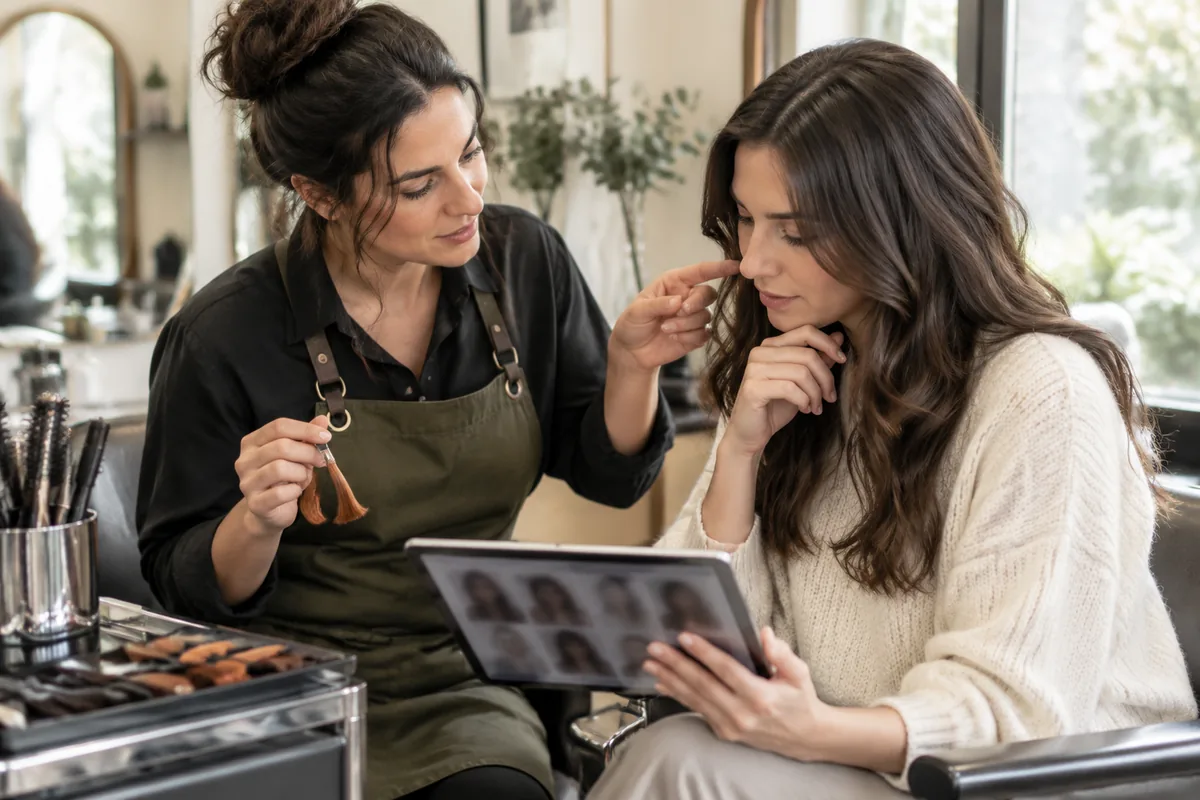
AI-generated illustration of a service conversation, not a real client case or a photographed haircut result.
That question belongs in a stylist-led consultation. The stylist checks starting length, hair condition, color history, maintenance, appointment duration, and price. They may recommend the cut without color, a staged color plan, or no added service. The preview is a visual prompt; it cannot supply that assessment or predict the final result.
For a first test, choose one hairstyle from your own gallery. Put a clearly labeled preview link beside it and keep the salon's consultation route visible on the gallery page. The website setup tutorial explains how to create the reference link. It opens WigTryAI as an ordinary external page; it does not add an embedded widget, a salon booking integration, or a salon analytics dashboard.
Before putting the link in front of clients, try the same reference on your own photo. Ask which service question the example helps you explain. If it changes the hairline, adds implausible density, or makes the color look more certain than it is, do not use that output as a service promise.