

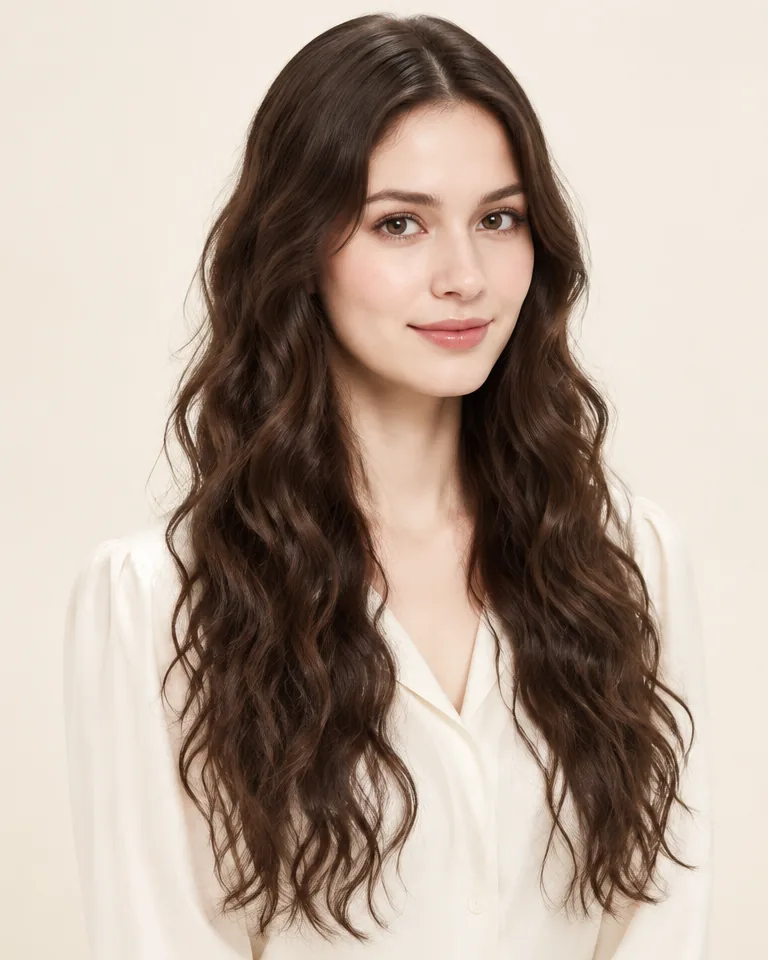
Water wave
Smaller bends repeat more often down the visible length and make a busier surface in this illustration.
Try Water waveHairstyle comparison
In these references, water wave has smaller, less regular ripples; body wave has broad, relaxed S bends. Compare the specific dry pattern. The name does not establish density, fiber or maintenance.
Quick answer
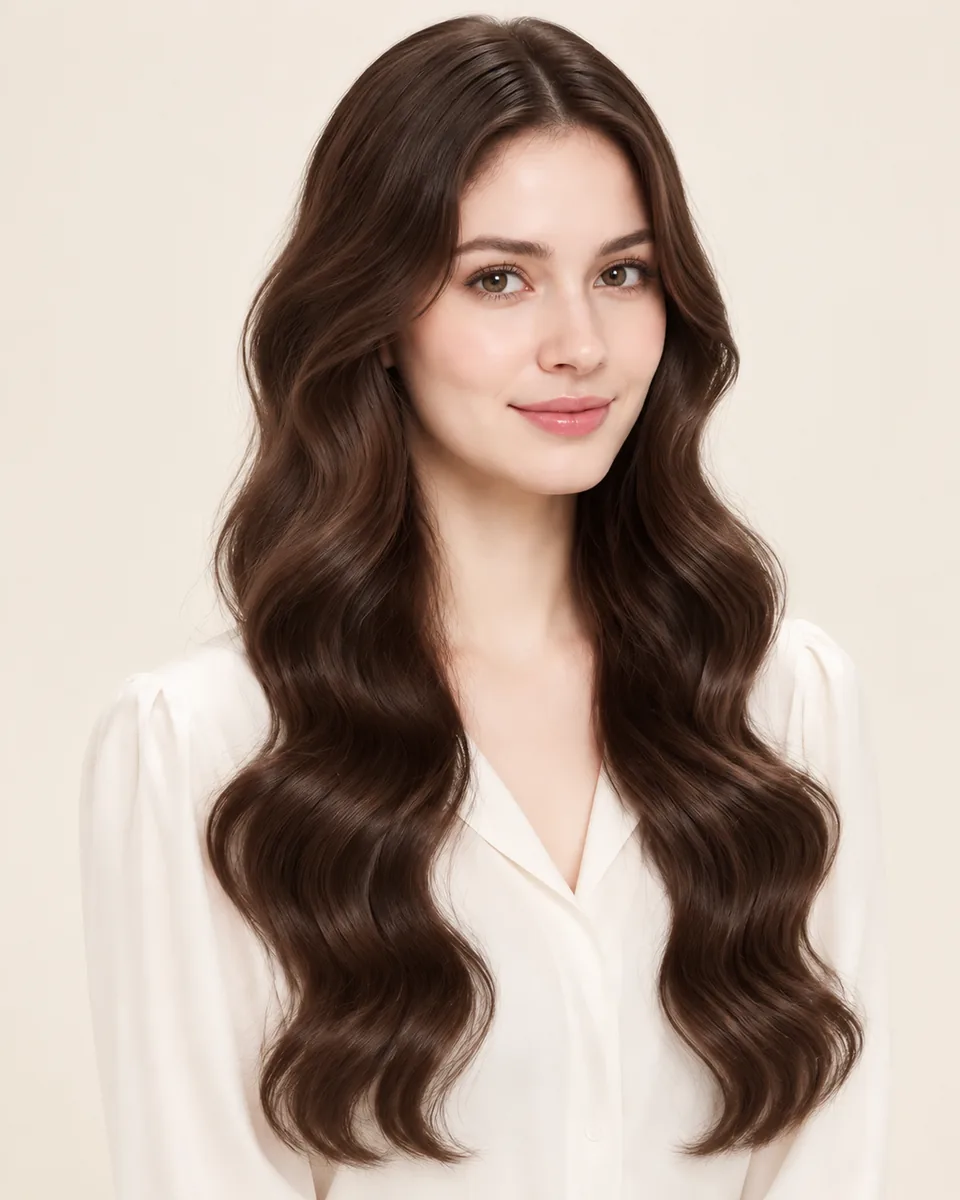
In the references here, water wave means smaller ripples with changing directions; body wave means wider, more relaxed S bends. Start with how often the hair changes direction between cheek and chest. Texture names are useful labels, but they do not set a universal curl measurement or quality grade.
Visual comparison
AI-generated editorial illustrations based on the same model, with comparable color and framing. They are not customer results or a measured test. Head scale and framing also differ slightly. Compare the visible examples, not a single-variable experiment; each label allows other variations.
Smaller bends repeat more often down the visible length and make a busier surface in this illustration.
Try Water waveLonger, shallower curves create a quieter surface at a comparable visible endpoint.
Try Body waveTrace a section beside the face. A broad bend takes more vertical space before turning back; a smaller ripple changes direction more often. Then inspect the whole outline. Two patterns can have a similar endpoint while occupying different amounts of visible space, but density, styling and camera angle also affect that impression.
Ywigs' own texture comparison describes body wave as the broader pattern and water wave as a more textured finish within that product range. Treat that as the brand's naming context, not a measurement shared by every wig, extension or natural hairstyle.
Decision guide
| Observation | Water-wave reference | Body-wave reference |
|---|---|---|
| Frequency of bends | More small changes of direction | Fewer broad S bends across a similar length |
| Surface rhythm | Less regular, separated ripples | Smoother connected curves |
| Outline | Inspect the actual dry side width | Inspect the actual dry side width |
| Visible length | Read the endpoint in the worn pattern | Read the endpoint in the worn pattern |
| What the name cannot tell you | Fiber, density, care or durability | Fiber, density, care or durability |
A naturally wavy head of hair, a heat-styled finish, a perm and added hair are different contexts. A wig or extension texture name does not identify someone's natural curl type. A body-wave perm is a chemical service, not another name for a body-wave reference image.
If you are comparing added hair, the actual fiber and construction determine which care and heat instructions apply. If you are comparing styles for your natural hair, discuss what your existing pattern can do. Neither label establishes that water, heat or a particular brushing method will restore the pictured finish.
The body-wave guide covers its broader appearance. The water-wave guide covers the smaller-ripple direction. This comparison keeps the decision between those two patterns separate from material or installation advice.
Do not stretch one reference mentally while judging the other as worn. A stretched measurement and a visible dry endpoint answer different questions. Compare the pattern at the length and width you actually want around your face and shoulders.
A fuller-looking image does not prove that one texture always contains more hair. Density, grouping of strands and styling can change the outline. If retaining a quieter side silhouette matters, inspect both references at the cheeks and shoulders instead of assuming the wave name decides it.
For neighboring patterns, body wave vs loose wave compares broad flow with more separated bends. Deep wave vs water wave compares another tighter-pattern reference. Those comparisons do not make the labels a fixed scale across every source.
Before choosing, ask what routine applies to the actual hair and the finish you want to maintain. A broad pattern is not automatically effortless, and a smaller pattern does not come with a predictable number of days of definition. Avoid instructions based only on the words water or body.
If your goal is a temporary visual change, decide whether you like the ripple density before investigating the real styling method. If the image is intended for a salon conversation, bring a dry reference and explain whether you want the pattern near the roots, mainly in the lengths or concentrated at the ends.
Open one reference, upload a clear photo showing the head and upper chest, and make a preview. Repeat with the other reference and the same photo. Compare bend frequency, dry-looking width and endpoint. These are separate generated images; color and facial details may vary with the references.
Use virtual hairstyle try-on to explore more patterns. AI illustrates a direction; it cannot test fiber, detangling, actual shrinkage, washing response or how long a style will last.
The water-wave example here has smaller, more frequent bends than the body-wave example. Labels vary across sources, so compare the actual pattern rather than treating the names as a fixed curl scale.
No. Density, strand grouping, length and styling also affect the outline. Inspect the dry-looking width in the specific reference or actual hair.
People may use them informally for an appearance, but they are also common added-hair labels. They do not identify a universal natural curl type or imply a perm service.
The name alone cannot establish that. Fiber, construction, natural texture, styling method and the finish you want to retain determine the appropriate routine.
No. The generated portrait illustrates a pattern. It does not test washing, wet-to-dry behavior, durability or care instructions for real hair.
