
Deep Wave Vs Water Wave
Deep Wave vs Water Wave: Repeated Waves or Irregular Ripples?
Deep wave usually reads as more repeated, defined waves; water wave usually reads as ripples changing direction between sections. Start with the actual dry reference: the names do not standardize density, care or material quality.
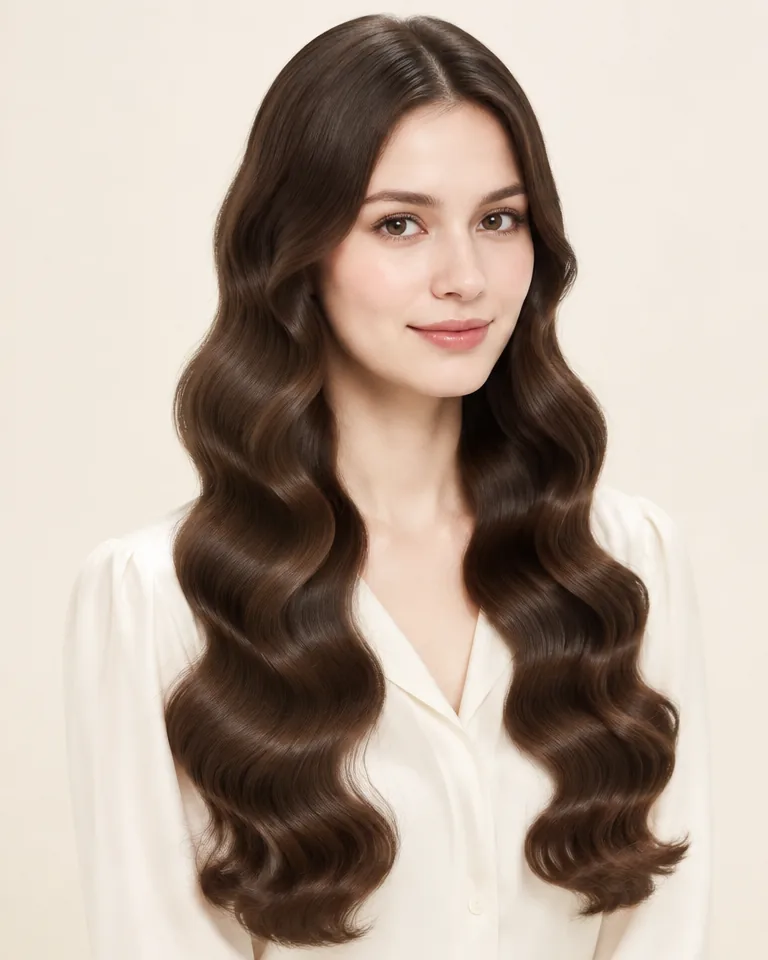

Deep Wave Vs Water WaveHairstyle comparisonHairstyle preview
3 min read
Visual comparison
Deep wave or Water wave?
AI-generated editorial illustrations of the same model. They isolate a visual direction; they are not customer photos or actual try-on results.
Deep wave
This selected deep-wave illustration uses broad, repeated bends. The label does not standardize wave size across sources.
Try Deep waveWater wave
Look for neighboring sections that change direction and separate into a less aligned surface.
Try Water waveQuick answer
Compare repetition before fullness
Deep wave usually describes a regularly repeated, defined wave pattern. Water wave usually describes ripples that vary more in direction and separation. Compare the rhythm of the mid-lengths before you compare fullness: density, brushing, wet styling and the camera angle can make either example look larger.
The selected illustration shows a broad, aligned deep-wave example beside a finer, irregular water-wave example; it does not establish a universal size ordering. These names are common in wigs and extensions as well as hairstyle references. They are commercial style labels, not standardized curl grades or proof of fiber quality. A “water wave” reference from one source may resemble a “deep wave” example from another. Read the actual pattern rather than treating the label as a measurement.
In its own texture comparison, UNice describes deep wave as more directionally consistent and water wave as less aligned. That is useful context for the labels, not a universal test of every wig or a basis for predicting durability. Our water wave guide focuses on reading the ripple itself.
Inspect Three Details at the Same Displayed Length
- The first full bend beside the face. A pattern starting near the cheek changes the side frame more than one beginning below the jaw. Compare where it begins as well as how tight it is.
- The repeating rhythm through the middle. Deep-wave examples often form more legible repeated S shapes. Water-wave examples often have neighboring sections curving in different directions. Neither needs to be perfectly uniform or completely random.
- The width when dry. A wet-look photograph can make separate ripples look narrow and glossy. A separated dry finish may occupy more space. Match the finish and the displayed endpoint before deciding which silhouette you prefer.
If you mainly want a larger, softer bend, body wave vs deep wave is the more relevant comparison. This page holds attention on pattern alignment between two more defined directions.
Decision guide
Choose the visual pattern you want
Use comparable dry references. The labels alone cannot establish upkeep or actual material behavior.
| What you are choosing | Deep-wave starting point | Water-wave starting point |
|---|---|---|
| Wave rhythm | A more repeated, aligned S shape | More varied directions between sections |
| Surface detail | Read each repeated ridge and trough | Read separation and irregular ripples |
| Face frame | Check where the first repeated bend begins | Check which separated sections sit beside the cheek |
| Displayed length | Compare the dry endpoint in the photo | Compare the same dry endpoint, not a pulled strand |
| Care expectations | Use the actual fiber and maker instructions | Use the actual fiber and maker instructions |
The Label Does Not Set Tangling, Shrinkage or Care
Do not assume deep wave always lasts longer, water wave always tangles less, or either needs a fixed wash routine. Actual behavior depends on the hair or fiber, its condition, construction, finishing and handling. A still photo cannot establish those properties.
The same caution applies to length. A labeled length on a wig or extension may be measured differently from the endpoint visible in a styled photo. For a visual comparison, choose references ending at the same place on the body; that does not mean the underlying strands are the same length or will shrink by the same amount.
If you want a wet-looking finish, distinguish appearance from being wet. Water wave is a texture name; it does not require constant moisture or tell you whether a product or heat tool is suitable. Follow the instructions for the actual hair or fiber instead of borrowing a routine from a texture name.
Compare Both on One Portrait
In virtual hairstyle try-on, use the deep-wave and water-wave cards above on the same portrait. Keep the selected color and length consistent, then look at pattern definition, cheek-level width and the ends as separate features.
Both catalog presets are starting directions. AI can alter strand detail and apparent density, so the outputs are visual references rather than a controlled physical texture test. They cannot verify a particular wig, reproduce exact product specifications, predict washing or detangling, or establish how your natural hair will hold a set. If an exact reference matters more than the label, use the reference hairstyle try-on with a clear image you can use.

Need a starting silhouette before choosing a wave?
Get hairstyle suggestions from your photo, then use the wave comparison to refine the width and pattern you prefer.
Find my hairstyle starting pointFAQ
Is water wave curlier than deep wave?
There is no universal ordering. The labels vary by source, and the finish can change how tight a pattern looks. Compare bend size and direction in actual dry references instead of using the name as a curl grade.
Does water wave mean the hair must stay wet?
No. It is a texture label, not an instruction to keep hair wet. A wet-look finish is a separate styling choice, and its suitability depends on the actual hair or fiber and its care instructions.
Which pattern tangles less?
The name cannot reliably answer that. Material, hair condition, strand length, construction and handling all affect tangling. A generated preview cannot test those properties.
Why do two wave styles look different at the same labeled length?
The displayed endpoint depends on the pattern and styling, while a source may label length using a different measurement. Compare where the dry ends sit on the body when choosing a visible silhouette.
Can I use these presets to verify a particular wig?
No. The presets illustrate hairstyle directions on your portrait. They do not verify a product, cap fit, fiber quality, exact density or its behavior after washing.