
Bixie vs bob
Bixie vs Bob: Which Short Haircut Should You Try?
Both cuts can end near the jaw at the front. What differs is everything behind the front: a bixie keeps its length in the side-swept bangs and tapers the nape, while a bob carries its perimeter all the way around your head.
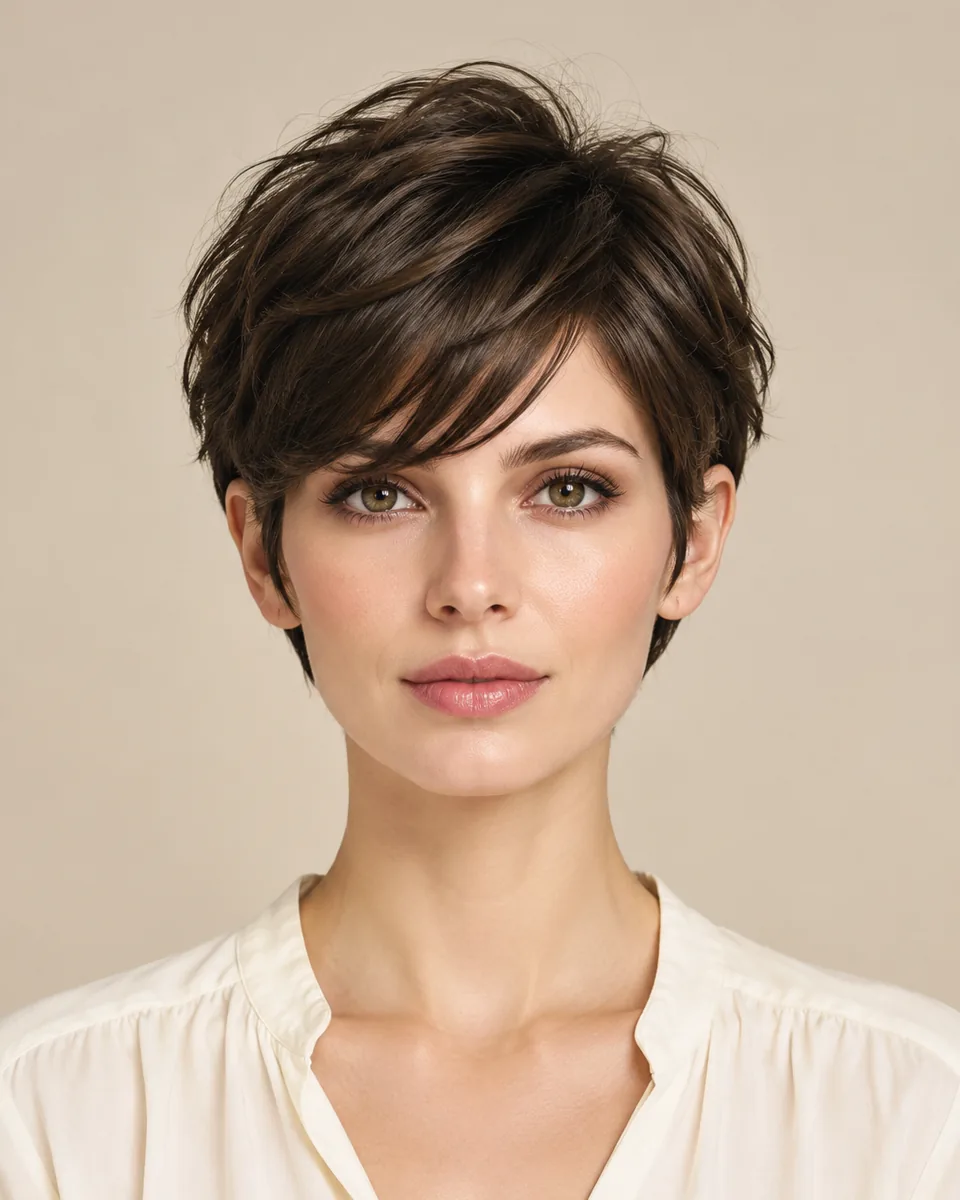

Bixie vs bobBixie cutShort bob comparisonShort haircuts
7 min read
Quick answer
Which one should you try?
Choose the bixie if you want the top of a pixie with length in the front: exposed ears, a tapered nape, and one long side-swept bang doing the face framing. Choose the bob if you want hair to continue around the back and sides, an even outline at the jaw, and the option to tuck or pin it.
- Length placement
- Bixie: the front pieces only · Bob: all the way around
- Ears and nape
- Bixie: ears open, nape tapered · Bob: hair over the lower ear and at the neckline
- Face framing
- Bixie: one diagonal sweep across the forehead · Bob: vertical sides at the jaw
- Grow-out
- Bixie: the sides and nape grow toward a short bob · Bob: the perimeter drops below the jaw
Where the length actually sits
The names suggest a length difference. Most of the time there is not one: a bixie and a chin-length bob can finish at the same point in front. What separates them is the geography of the haircut. A bob takes one length and carries it around the head, which is why the perimeter reads as a single line from the jaw on one side to the jaw on the other. A bixie takes length and puts it where the face needs it, in a long side-swept bang and a soft side piece, and then cuts everything else short.
That is why the two cuts look far more different than their front length suggests. On a bob, the sides are still hair hanging past the cheek. On a bixie, the sides are cut back to the ear, the crown is cut piecey so it stands up on its own, and the nape is tapered to a clean point at the neck. The long bang is doing all of the framing work by itself.
A bob keeps its length at the outline. A bixie keeps its length at the front.
Bixie vs bob, side by side
Visual comparison
What changes between the two
Same face, same color. Look at the ear, the nape and the direction the front hair travels.
Bixie
One diagonally swept bang crosses the forehead, the ears are fully visible, and the back tapers into the neck. The silhouette is wider at the crown and narrow at the nape.
Try BixieChin-length bob
Hair continues around both sides and the back, so the ends form an even line at the jaw and the lower ear sits under the hair. The silhouette is a rounded rectangle.
Try Chin-length bobEars, neck and the line around the jaw
Three visible points decide the comparison, and none of them is about short versus long.
The ear. A bixie exposes it completely, including the top where the sideburn would be. A chin-length bob covers the lower half or all of it, depending on where the stylist places the side section. Exposed ears make the face read as more open and make the crown the widest part of the shape; covered ears push the visual weight down to the jaw.
The nape. A tapered bixie nape ends close to the neckline, so the neck looks longer and the haircut stops before the collar. A bob keeps hair at the neckline, which fills that space and makes the head-to-shoulder transition look heavier. If you wear collars or high necklines often, that difference is more noticeable than any measurement on the front.
The front direction. This is the one people underestimate. A bixie frames with a diagonal: the bang sweeps from a part across the forehead and ends near the cheekbone. A bob frames with verticals: two side sections that fall straight down the jaw. A diagonal softens and narrows; verticals define and, if the perimeter lands at the widest point of the jaw, can widen it. Neither is better, but they solve different problems, which is why swapping one for the other sometimes feels like a bigger change than the length suggests.
The short ladder: pixie, bixie, bob
Decision guide
Which starting point matches what you want?
Sort by the thing you would miss least, not by how short the name sounds.
| If you want | Try | Watch for |
|---|---|---|
| The shortest version, with nothing on the neck | A textured pixie | Sides and nape show growth within a few weeks |
| A pixie top with real length in the front | A bixie with a long side-swept bang | Crown texture needs product to stay piecey on day two |
| A continuous line at the jaw and hair at the neckline | A chin-length or blunt bob | The perimeter shows every uneven growth week |
| To keep your options open on the same photo | Preview all three, then decide | A preview shows the shape, not how your density behaves |
Density and texture change the advice
The same pair of cuts behaves differently on fine and thick hair, which is why a bixie can be the cautious choice for one person and the risky one for another.
A bixie asks the crown to hold a shape with almost nothing underneath it. On fine hair that means the piecey top depends on texture and a little product rather than on density, and there is no longer side hair to fall back on if the crown drops. On thick hair the same crown can mushroom upward, because there is no length at the sides to weigh the shape down.
Growth direction shows up immediately in a bixie. With the sides cut back, a cowlick at the temple or a strong swirl at the crown has nothing to hide behind: the front piece sweeps over it or it does not. A bob is more forgiving here, because the side sections and the perimeter give a wayward section somewhere to sit. That is the trade: the bixie is more decisive about the top of your head, and less forgiving if the top does not cooperate.
How often each shape gets picked
WigTryAI's 2026 dataset records 10,000 completed generation events across a 29-style picker. In that sample, the Bixie + Side Bangs card was picked 218 times (2.18%, ranked 20th), the Pixie Cut card 227 times (2.27%, ranked 19th), and the Blunt Bob card 537 times (5.37%, ranked 6th). Blunt Bob is a separate catalog card from the Classic Bob previewed on this page, and it is the closest bob row in this snapshot.
The observed part is simple: the Bixie and Pixie cards landed within nine events of each other, while the Blunt Bob card drew roughly two and a half times as many picks as the Bixie card did. One reading, and it is an interpretation rather than a measurement, is that bridge cuts are usually introduced in the chair: someone asks for a bob or a pixie, and the bixie appears as the compromise. The dataset cannot confirm that. It records completed generations only, not why a card was chosen, what was booked afterwards, or what was kept.
The numbers also carry a plain caveat. The catalog label is "Bixie + Side Bangs," not "bixie," and a compound label is easy to skim past. Read the ranking as what this picker recorded, not as what people prefer in general. The full method and limits sit in the 2026 AI hairstyle trends report, and the least-tried hairstyles breakdown covers the bottom of the same table.
Compare both on one photo
Start with a straight-on portrait, hairline to shoulders, in even light. Keep the color, the part and the camera distance fixed, then switch between the bixie and the bob. Four things are worth checking, in this order:
- The ear. Does an exposed ear feel balanced on your face, or do you immediately want the hair back?
- The neckline. Look at where the haircut stops relative to your collar. A tapered nape and a bob perimeter read very differently on a long neck.
- The front direction. Compare the diagonal sweep with the two vertical sides. Which one moves the eye to your cheekbones rather than your jaw?
- The widest point. Find where the silhouette is widest in each version. On a bixie it usually sits at the crown; on a bob, at the jaw.
If the bixie wins but the crown feels too bare, the useful adjustment is a longer side-swept bang and a little more texture on top, not more length at the back.
Compare the two on your own face
One portrait, one color, two outlines. Switch between them until the ear and the neckline give you an answer.
Try a bixie and a bob on my photoWhat a preview can and cannot tell you
A preview shows the silhouette: where the length sits, how much of the ear is exposed, and how wide the shape reads beside your face. It cannot predict how your own crown texture will hold a piecey cut, how fast your nape grows, or how a stylist will adapt the reference to your hair. The portraits and the comparison figure on this page are editorial illustrations produced for WigTryAI. They show each direction clearly; they are not outputs from a real try-on and not photos of customer results.
Related comparisons and guides
If the decision is really about how short you are willing to go, the pixie cut vs bob comparison covers the wider version of that question. Once you have settled on short, the bixie vs pixie comparison narrows the same family down to the front piece. If the bob has won, the bob haircut try-on page starts from a chin-length cut and the bob hairstyles guide covers the variations.
Not sure which short direction fits your face?
Get a shortlist of looks with a reason for each, then come back and compare the bixie and the bob on the same photo.
Get my face-shape shortlistFAQ
Is a bixie just a short bob?
No. A short bob still carries its length around the back and sides, so it ends in a continuous line at the jaw. A bixie keeps length in the side-swept front, cuts the crown piecey and tapers the nape, so the ears and neck stay exposed. On the front they can look similar; from the side they do not.
Is a bixie shorter than a bob?
Usually, yes. A bixie sits in the pixie-to-bob gap: the top is pixie-short, the nape is tapered, and only the front pieces reach toward the jaw. A chin-length bob keeps every section at roughly the same length.
Do I need bangs for a bixie?
The long side-swept bang is what makes the cut read as a bixie rather than a grown-out pixie. Without it you are closer to a short textured crop. If you dislike hair across the forehead, ask for the length to sit at the cheekbone instead and sweep away from the face.
Which grows out more easily, a bixie or a bob?
They grow in opposite directions. A bixie gets easier as the sides and nape gain length, because they start moving toward a short bob. A bob shows its growth as a line that drops below the jaw, so it usually needs more frequent trims to stay precise.
Can I preview a bixie and a bob on the same photo?
Yes. Use one straight-on portrait and keep the color and part steady while you switch between the two cuts. Comparing the ear coverage and the neckline on the same face is more useful than comparing two reference photos of two different people.