
Bixie vs pixie
Bixie vs Pixie: What One Long Front Piece Changes
Both cuts leave the ears and the nape open. The difference is one piece of hair: the bixie keeps a long side-swept bang that crosses the forehead, and the pixie cuts the front short enough that nothing falls across your face.
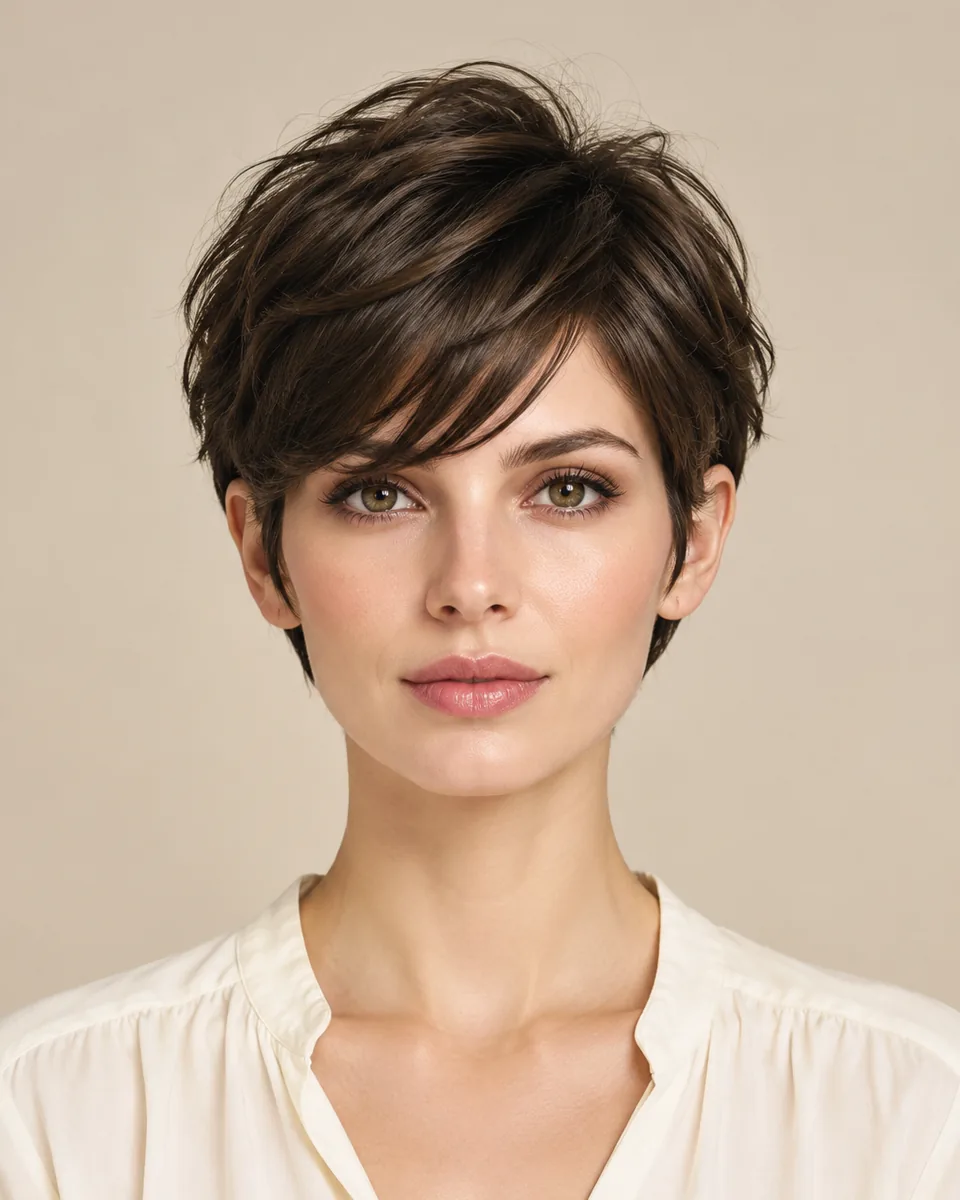
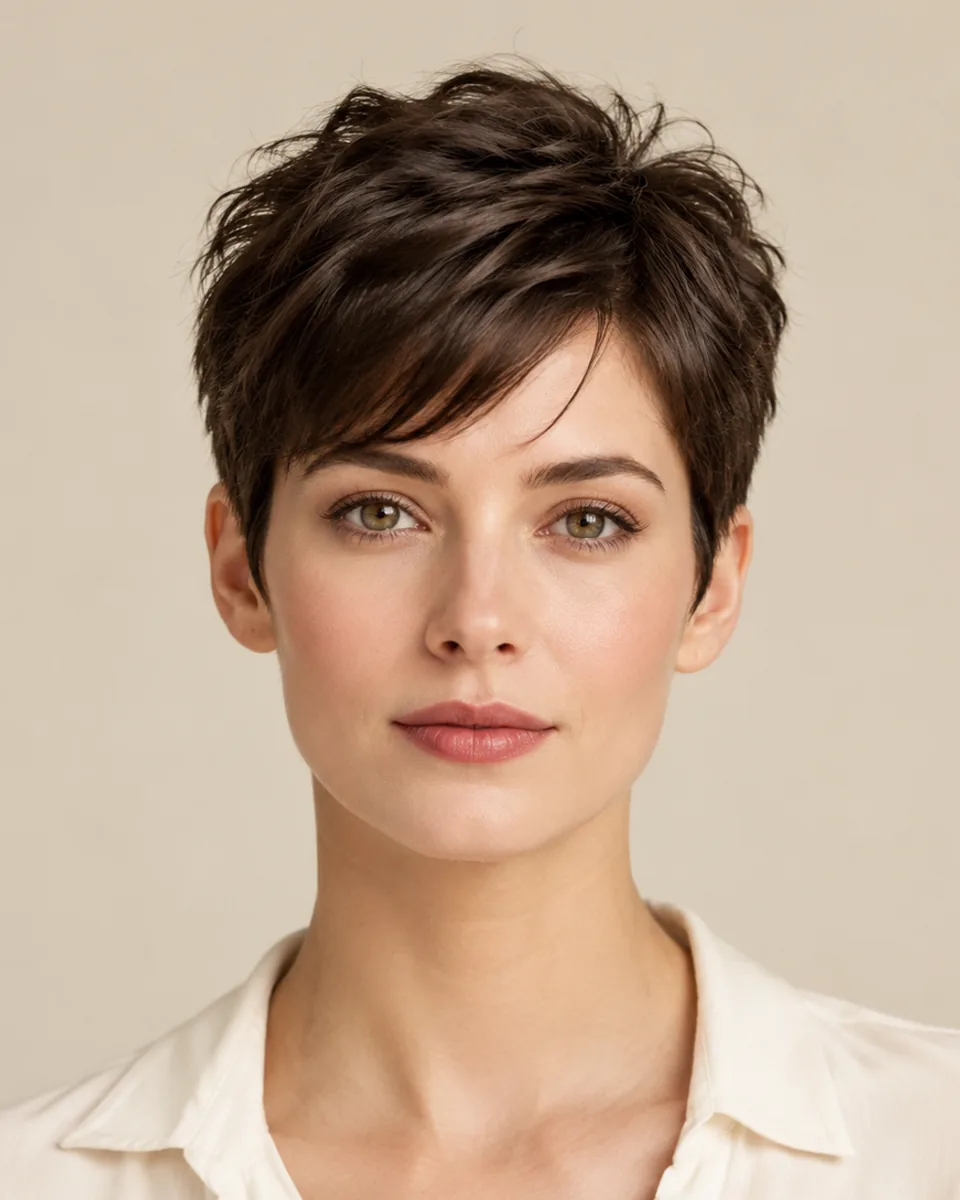
Bixie vs pixieBixie cutPixie cutShort haircut comparison
6 min read
Quick answer
Which one should you try?
Choose the pixie if you want the front cut short as well: a piecey fringe or a bare forehead, nothing to sweep aside, and a shape that is decided by the crown. Choose the bixie if you want the same short sides and nape with one long side-swept bang doing the framing, and you are willing to move that piece every morning.
- Sides and nape
- Short in both: ears exposed, nape tapered
- The front
- Pixie: short fringe or none · Bixie: one long piece to the cheekbone
- Forehead
- Pixie: brow stays clear · Bixie: the sweep crosses the brow line
- Morning routine
- Pixie: crown texture only · Bixie: crown plus one piece to place
The sides are the same decision
A bixie and a pixie are usually described as two different lengths, but that is not where the difference lives. Both cuts take the sides above or close to the ear, both taper or crop the nape, and both leave the neck open. If you ran a finger along the side of either one, you would find short hair cut close to the head.
The difference sits in a single section: the front. A pixie finishes the fringe short, so the forehead is either bare or covered by a short piecey fringe that stops well above the brow. A bixie lets one piece keep growing until it crosses the forehead diagonally and ends near the cheekbone. Everything else about the haircut is close enough that a bixie can be cut back into a pixie in a single appointment; the reverse takes months of front length.
Same short sides, same tapered nape. One version keeps a long piece in front, the other does not.
That is also why a long pixie keeps appearing in this conversation. Once the front piece grows past the brow and is directed into a side sweep, the shape starts reading as a bixie.
Bixie vs pixie, side by side
Visual comparison
What changes between the two
Same color and the same short sides. Look only at the forehead and at the piece that sits in front of the ear.
Bixie
The long side-swept bang crosses the forehead and ends near the cheekbone, so the front has length and direction. The sides stay short and the nape stays tapered.
Try BixieClassic pixie
The fringe is cut short and sits above the brow, the brow stays clear and there is no long piece to sweep. The shape reads from the crown and the temple line.
Try Classic pixieThe forehead question decides it
Put aside the words and answer one question: do you want hair falling across your forehead?
If the answer is no, the pixie is doing what you want. Nothing needs to be swept, nothing moves when you turn your head, and the haircut reads the same at eight in the morning as it does at eight at night. The trade is that a short fringe or a bare forehead puts the hairline and the top of your face on display, and there is no length to soften that.
If the answer is yes, the bixie gives you one long piece and the diagonal framing that comes with it. That piece can be swept to the side, pushed back, or left forward, which means the front of your face has three readings instead of one. The cost is that you now own a piece of hair: it needs to be placed, and on a windy day it will not stay where you put it.
Neither answer is better, and neither is about your face shape. It is about how much you want to interact with your own fringe before you leave the house.
Which one matches what you want?
Decision guide
Choose by the front, not by the length
The sides, ears and nape are close to identical. Decide on the front piece and the amount of daily maintenance you want.
| If you want | Try | Watch for |
|---|---|---|
| A clear brow and nothing to sweep | A classic pixie with a short piecey fringe | The hairline and crown become the whole shape |
| A diagonal frame across the forehead | A bixie with a long side-swept bang | The piece needs placing every morning and moves in wind |
| A pixie now that can become a bixie later | A pixie with a slightly longer front section | The in-between stage is the long pixie, not a clean pixie |
| To test both without committing | Preview both on one photo, then book | A preview shows the shape, not how your growth pattern behaves |
The long pixie is the honest middle
The long pixie is the name for the version that sits between the two, and it is worth naming rather than treating as a compromise. It keeps the pixie's short sides and open neckline, but leaves more length in the fringe and the temple area than a classic pixie. Compare it with a bixie and the two overlap: the difference is where the extra length is directed, not how much of it there is. A bixie sends it across the forehead in one sweep; a long pixie leaves it in a fuller fringe and beside the face.
So the practical question inside this family is not how short to go, but where you want the extra length to end up. If you want it crossing the forehead, ask for the bixie. If you want it above the brow and beside the face, ask for a longer pixie.
What the picker recorded
WigTryAI's 2026 dataset covers 10,000 completed generation events across a 29-style picker. The Pixie Cut and Bixie + Side Bangs cards came out almost level: Pixie Cut at 227 events (2.27%, ranked 19th) and Bixie + Side Bangs at 218 events (2.18%, ranked 20th). That is a gap of nine events.
It would be easy to read meaning into a gap that small, so here is the check. The same nine-event gap shows up between several neighbouring pairs in the lower half of the same table, including Goddess Braids (309) and Wolf Cut + Wispy Bangs (300), and Short Shag (191) and Curly Shag + Bangs (182). In this picker, a margin of nine events is ordinary spacing, not a verdict. What the numbers do support is narrower: the Pixie Cut and Bixie + Side Bangs cards were picked at nearly the same rate, and neither was picked often.
The usual caveats apply. The catalog label is "Bixie + Side Bangs," and one possible explanation for a low count is that a compound label is easy to skim past. The record counts completed generations, not people, preferences, or what anyone booked afterwards. The method and limits are in the 2026 AI hairstyle trends report.
Compare both on one photo
Start with a straight-on portrait, hairline to shoulders, in even light. Keep the color, the part and the camera distance fixed, then switch between the bixie and the pixie. Four things are worth checking:
- The forehead. Is the sweep covering a line you want covered, or is it in the way?
- The piece in front of the ear. The bixie leaves slightly more there. Does it soften the side of your face or make the shape untidy?
- The crown. With the front out of the way, both cuts stand or fall on the top of your head. Does the texture hold?
- The ear line. The cut sits close in both versions, so this is your chance to see how much ear you are comfortable showing.
If the bixie feels close but heavy, the fix is usually a shorter front piece, not more length at the sides.
Try both on your own face
One portrait, one color, two fronts. Switch between them and watch only the forehead and the ear line.
Try a bixie and a pixie on my photoWhat a preview can and cannot tell you
A preview shows the shape: how much of the forehead the front piece covers, where it ends beside the cheekbone, and how open the sides look. It cannot tell you how your own crown will hold a piecey cut, how your hairline behaves under a short fringe, or how fast the front piece grows out between trims. The portraits on this page are editorial illustrations produced for WigTryAI. They show each direction clearly; they are not outputs from a real try-on and not photos of customer results.
Still deciding how short to go?
Get a shortlist of looks with a reason for each, then come back and compare the bixie and the pixie on the same photo.
Get my face-shape shortlistRelated comparisons and guides
The pixie cut try-on page starts from a classic pixie if that is the direction you have chosen, and the pixie hairstyles guide covers the variations. If the real question is how much of your face you want covered, the pixie cut vs bob comparison covers the wider version of it.
FAQ
Is a bixie just a long pixie?
Close, but not the same thing. A long pixie keeps extra length in the fringe and temple area while still reading as a pixie. A bixie directs that length into one long side-swept bang that crosses the forehead, so the front has a clear diagonal instead of a short fringe.
Which one is easier to style in the morning?
A classic pixie needs the crown to hold its shape and nothing else. A bixie needs the same crown work plus one piece placed across the forehead, so it takes a little longer and reacts more to wind and humidity.
Will a bixie cover my forehead?
Partly. The side-swept bang crosses the forehead on a diagonal, so it covers one side and leaves the other open. If you want full coverage, ask for a fuller fringe; if you want none, a pixie is the honest choice.
Which grows out more easily?
A bixie usually tolerates a longer gap between trims, because the longer front piece distracts from the sides and nape growing out. A pixie shows that growth first, since those sections are cut closest. Both still need trims to stay deliberate, and a bixie's front piece grows past the cheekbone quickly, so the shape drifts if you leave it too long.
Can I preview a bixie and a pixie on the same photo?
Yes. Use one straight-on portrait and keep the color and part steady while you switch between the two cuts. Compare the forehead and the ear line on the same face rather than comparing two reference photos of different people.