Original research/Report 1.0

The Hairstyles People Rarely Try, Even When Trying Is Free

A preview costs nothing, which is exactly why the bottom of the ranking is worth reading. Ten hairstyles in the WigTryAI catalog were generated fewer than 220 times each out of 10,000 completed events. The list records what people rarely tried — not a verdict on how those styles look.

Methodology & limitations
Original researchHairstyle statisticsBold haircutsAI hairstyle try-on

Quick answer

What the bottom of the list shows

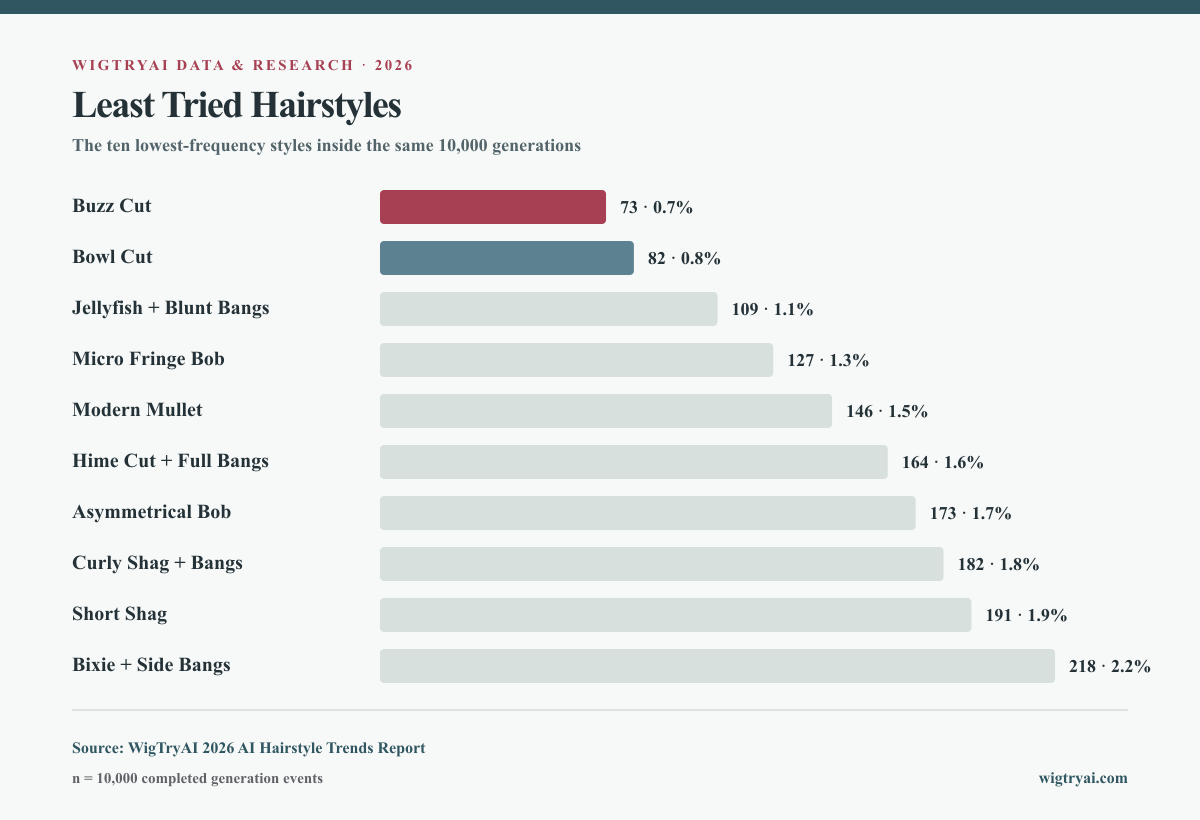
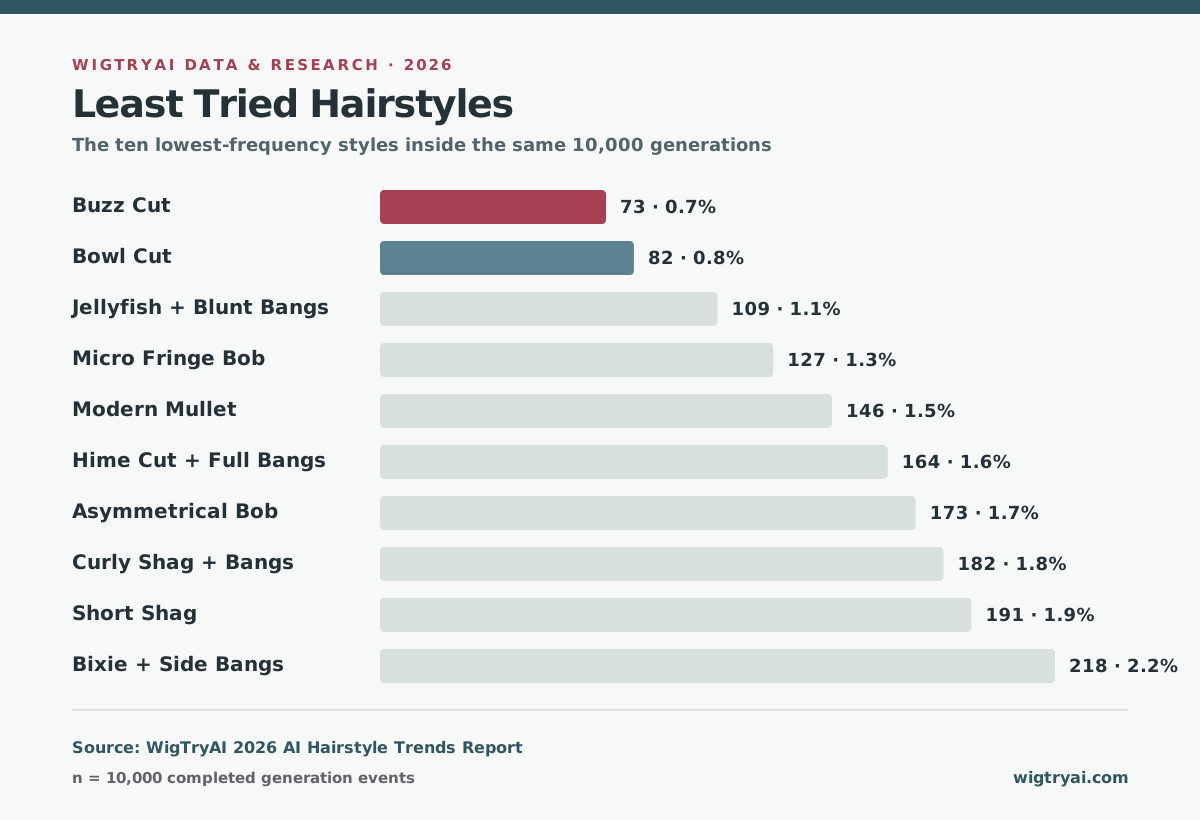
In 10,000 completed generation events, the ten least generated hairstyles together accounted for 1,465 events — 14.7% of the sample. Buzz Cut came last with 73 events (0.73%), and the five lowest-frequency styles together reached 537 events, 5.4%. Every one of them could be previewed on a photo at no cost. The counts measure how often a style was generated inside one catalog, not how a style looks on a person.

Least tried style
Buzz Cut · 73 events
Bottom ten
1,465 of 10,000 · 14.7%
Bottom five
537 events · 5.4%

Put a bixie on your own photo and you can see the change for yourself. In the dataset behind the 2026 AI Hairstyle Trends Report, 29 hairstyles sat in the same picker, all equally free to preview — and the rarest of them stayed rare. Bixie + Side Bangs, the highest-ranked style in the bottom ten, accounted for 218 of 10,000 completed generation events.

That is the part of the data worth a second look. The top of the ranking has been covered. This is the other end: what sits at the bottom, and what it means if one of those styles is the one you keep opening.

The Least Tried Hairstyles in the Catalog

Continuing the report's ranking: ten of the 29 labeled styles were generated fewer than 220 times each.

Rank Hairstyle Generations Share
20 Bixie + Side Bangs 218 2.18%
21 Short Shag 191 1.91%
22 Curly Shag + Bangs 182 1.82%
23 Asymmetrical Bob 173 1.73%
24 Hime Cut + Full Bangs 164 1.64%
25 Modern Mullet 146 1.46%
26 Micro Fringe Bob 127 1.27%
27 Jellyfish + Blunt Bangs 109 1.09%
28 Bowl Cut 82 0.82%
29 Buzz Cut 73 0.73%

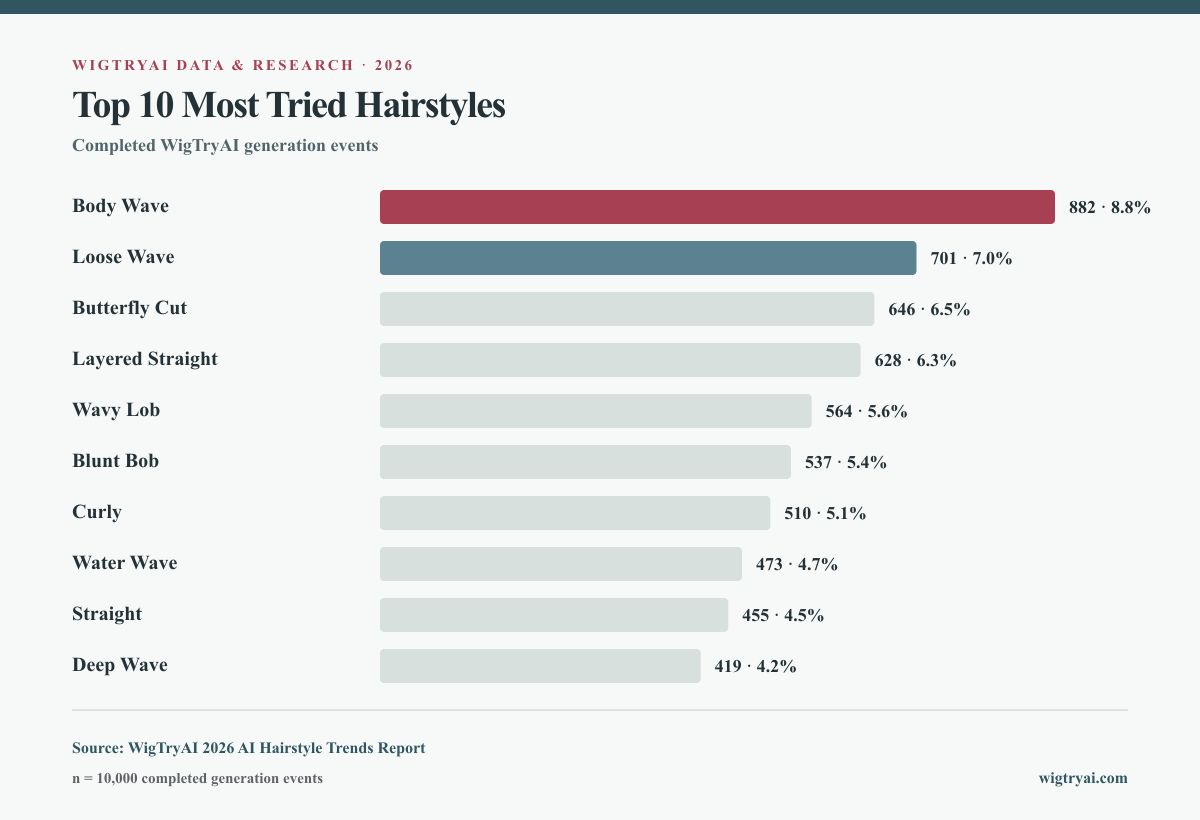
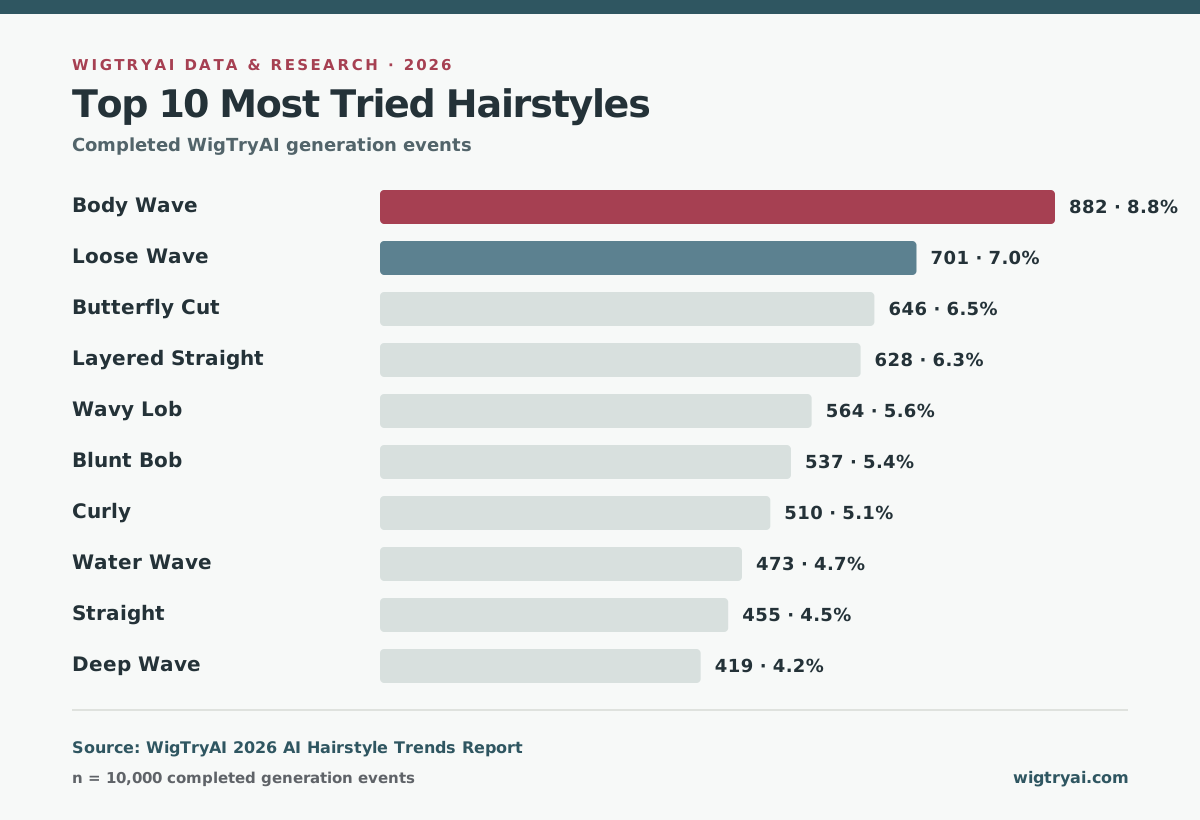
Between them, these ten accounted for 1,465 of 10,000 events. The five at the very bottom — Modern Mullet, Micro Fringe Bob, Jellyfish + Blunt Bangs, Bowl Cut, and Buzz Cut — reached 537 events, 5.4% of the sample. For scale: a single style at the top, Body Wave, was generated 882 times on its own.

Low Counts Measure Trial, Not Taste

The dataset records completed generations. It does not record whether anyone kept the image, showed it to a stylist, or sat in a chair. Nobody in this data is committed to anything. So treat the bottom of the list as a measurement of how often a style gets generated inside one tool, and read the rest as structure.

Two structural reasons explain part of the gap without saying anything about the styles themselves.

Compound labels sit behind simpler searches. "Bixie + Side Bangs," "Hime Cut + Full Bangs," and "Jellyfish + Blunt Bangs" each describe two ideas at once. A person who comes looking for a bixie, a hime cut, or a jellyfish cut may never open the card that carries the extra description with it, even when that card is the closest match in the catalog.

Browsing favors the recognizable. Wave textures and bobs are easy to recognize from a thumbnail, so they get opened while someone scrolls. A bowl cut or a French crop needs to be seen on a face before it means anything, and that takes a decision to open it in the first place.

Neither explanation makes the counts wrong. They make the counts a record of first moves.

Why the Rare Styles Are the Hardest to Read From a Photo

If you are drawn to one of the low-frequency styles, the preview becomes more useful than it is for a wave — and harder to interpret. Four things decide the outcome, and only one of them is visible in the image.

  • Whether the style changes your outline. A body wave changes texture inside the silhouette you already have. A buzz cut, a bowl cut, or a micro fringe bob replaces the outline itself: your jaw, neck, ear line, and hairline become the subject. Preview the extreme version once just to see what your outline does when there is no hair softening it.
  • What grows back first. Buzz Cut and Bowl Cut were the two rarest styles in the dataset, and they are also the two with the least forgiving grow-out. A pixie grows into a bixie and then a short bob, which gives you three usable stages. A buzz cut grows into one awkward length before it becomes a pixie.
  • How much styling the shape needs. Modern Mullet and Jellyfish + Blunt Bangs are texture-dependent: they read as two separate decisions — the layering and the finish — and the finish is what takes minutes every morning. A photo cannot show you the difference between a five-minute version and a twenty-minute version.
  • Whether you are really deciding about fringe. Micro Fringe Bob and Jellyfish + Blunt Bangs are as much a fringe choice as a cut choice, and fringe is where the dataset shows the strongest pull toward softness: within the bang and fringe subset (n = 1,764), Curtain Bangs took 22.2% and Wispy Bangs 17.0%, while Blunt Bangs were the rarest fringe at 6.2%. If the cut you like comes with a hard fringe, check the fringe separately before you commit to the shape.

How to Test a Rare Style in Stages

A rare style is usually a big change, and big changes are exactly what a free preview is good at. The mistake is testing only the extreme version, deciding it is "too much," and closing the tab.

  1. Generate the extreme version once — for information, not for a decision. You are learning what the silhouette does to your face, not auditioning the final look.
  2. Step one level back toward wearable. Buzz Cut to a cropped pixie. Bowl Cut to a French bob. Hime Cut to a blunt bob. Jellyfish to a layered shag. The second version is the one that has a chance of being worn.
  3. Keep the photo and the color fixed while you move. Change the shape only, so you are comparing shape and not lighting, camera angle, or color.
  4. Stop when you reach a version you could maintain. That is the version worth discussing, not the one that made you laugh.
Decision guide

Which version should you actually test?

The style you keep opening is usually one step more extreme than the style you would wear.

The style you keep openingTest this version firstWhat usually decides it
Buzz Cut or Bowl CutA cropped pixie, after one look at the extreme versionHow your jaw, neck, and ear line read with no hair around them
Bixie or Pixie CutThe longest pixie before it becomes a bobThe line at the neck and how the shape grows out
Modern Mullet or Short ShagA short shag with soft layersMornings: how much texture work the finished shape needs
Jellyfish or Hime CutThe fringe on its own, before the full cutForehead coverage and how often the fringe needs trimming
Micro Fringe BobA blunt bob without the micro fringeWhether you want a trim every three to four weeks

Then put two of those versions side by side on the same photo, using the one-variable comparison method, and keep the one you would recognize yourself in. If neither version survives that test, the rare style was a good exploration and not a good haircut — which matches what the counts already suggest about most of the catalog.

Test the extreme version once

Start with the version you would never book, look at what it does to your outline, then step back one level. One photo, one color, two versions — that is the whole test.

Preview a bold style on your photo

What the Counts Cannot Tell You

This finding is easy to overstate. The boundaries:

  • No commitment data exists in the sample. The dataset ends at the generate button. It cannot show who cut their hair, who kept it, or who regretted it.
  • Catalog structure shapes the counts. Styles with more variations in the picker accumulate more events, and compound labels are harder to find by name.
  • Repeat generations are included. One person can generate several styles in a session, so these numbers describe activity, not a survey of people.
  • There are no recorded motives. Nothing in the data says why a style was opened or avoided; the readings above are explanations, not measurements.
  • This is one product, one snapshot. The numbers describe WigTryAI's catalog in the dataset published July 22, 2026, not hairstyle behavior everywhere.

The measured fact is the distribution. What it means for your own hair is decided on your own photo — and, for the bolder styles on this list, in a conversation with a stylist before anything is cut.

Publisher evidence pack · version 1.0

Take the number with its source attached.

Copy attribution-ready wording or download charts and aggregate data. Every asset preserves the report version and denominator.

Cite this research

WigTryAI. (2026). 2026 AI Hairstyle Trends Report: What 10,000 Completed Try-Ons Reveal. Version 1.0. Published July 22, 2026. https://wigtryai.com/blog/ai-hairstyle-try-on-trends-2026

For online articles

According to WigTryAI's analysis of 10,000 completed hairstyle generation events, the ten lowest-frequency hairstyles together accounted for 1,465 of 10,000 try-ons (14.7%), with Buzz Cut last at 73 events (0.73%).

Key statistics for publishers

Ten least tried styles

14.7%

1,465 of 10,000 generation events

Least tried hairstyle

Buzz Cut

73 of 10,000 generation events · 0.73%

Chart downloads

Least tried hairstyles by generation events

Top 10 hairstyles by generation events

Read the full ranking

The report lists all 29 styles with their counts, plus the family, length, color, and fringe breakdowns, the methodology, and the downloadable aggregate dataset behind every number here.

Open the full 10,000-try-on report

FAQ

What is the least tried hairstyle in the dataset?

Buzz Cut, with 73 of 10,000 completed generation events (0.73%), followed by Bowl Cut at 82 events (0.82%) and Jellyfish + Blunt Bangs at 109 events (1.09%). All three were available in the same catalog as the most-tried styles, so the gap reflects how rarely they were generated, not how hard they were to preview.

Does a low try-on count mean a hairstyle looks bad?

No. The dataset records how often a style was generated — it contains no ratings, no feedback, and no follow-up. A style can be rare because it is extreme, because its label is hard to search for, or because it is hard to imagine from a thumbnail. The counts describe trial activity inside one catalog, not quality or suitability.

Were these rare styles actually available to preview?

Yes. The report covers 29 labeled hairstyles from the same catalog, and the rare ones sat beside the popular ones. Buzz Cut, Bowl Cut, Modern Mullet, Micro Fringe Bob, and Hime Cut + Full Bangs were all one selection away from the styles that dominated the ranking.

Do the numbers show whether people actually got the haircut?

No, and this is the most important limit of the dataset. It ends at the completed generation. There is no record of appointments, cuts, or follow-ups, so nothing here can tell you who committed to a style or how it turned out in a salon.

Should I avoid a style because it is rare in the data?

That would be reading the numbers backwards. A rare style usually means it is a bigger change, which makes a staged preview more valuable — generate the extreme version once to see your outline, then step back to the version you could maintain. The data tells you what other people explored; it cannot tell you what suits you.

How should publishers cite these figures?

Use the citation and the aggregate dataset attached to the 2026 AI Hairstyle Trends Report. Every count on this page traces back to that version 1.0 dataset of 10,000 completed generation events, and the bottom-ten share is calculated on the same 10,000-event denominator.

Related research and hairstyle guides