
Face-shape reading guide
What Is My Face Shape? Read It From a Photo
You do not need a tape measure to name your face shape. One neutral photo, three landmarks, and one length-to-width comparison get you a label accurate enough to shortlist hairstyle directions — which is the only thing the label is for.
Face shapeFace readingHairstyle decisions
6 min read
Quick answer
Read three landmarks, judge one ratio
To find your face shape, take one front-facing photo with your hair pulled back, then compare three landmarks: forehead width, cheekbone width, and jaw width. Note which reads widest, whether the face reads longer than it is wide, and whether the jaw reads angular or tapered. Cheekbones widest with both forehead and chin narrower points to diamond; cheekbones widest with a narrow chin points to heart; similar widths with an angular jaw point to square; cheeks widest with a soft jaw and length close to width point to round; clearly longer than wide with a soft taper points to oval. The label is approximate, and it only has one job: building a shortlist of hairstyle directions worth comparing.
- Photo setup
- Front-facing, hair back, even light
- The three landmarks
- Forehead, cheekbones, jaw
- The one ratio
- Face length vs cheekbone width
- Precision needed
- Rough — the label only shortlists
Most people asking this question have already taken a quiz, and two quizzes gave them two answers. That is normal. Face shape is not a measurement with a correct answer; it is a rough description of an outline that changes with camera distance, expression, and how much hair is covering it. The method below gets you a label that is useful for one thing — deciding which hairstyle directions to compare next.
Why the Quiz, the Mirror, and the App Disagree
The tape-measure version of this test implies that a face has stable numbers. It does not, for reasons you can check yourself:
- Hair is the biggest confounder. Long hair falling along the face adds width the skull does not have. This is why the mirror answer and the photo answer so often differ — in one, your hair frames the outline; in the other, it is part of the outline.
- Selfie distance rounds the face. A front camera held at arm's length sits inside the lens's distortion range: the nose and mid-face get emphasized and the outer face compresses. The farther the camera, the closer the photo is to how other people see you.
- A smile widens the cheeks. The same face reads wider in a grinning photo than a neutral one. Quizzes never ask about your expression.
- Filters change geometry. Beauty filters slim the jaw and enlarge the eyes by design. A filtered photo measures the filter.
- The mirror flips left and right. Most faces are slightly asymmetric, and a flipped view can make the wider side feel wrong in a way that nudges your read.
None of this means the label is useless. It means the label is a starting point, and a rough one — which is exactly how the method below treats it.
The Photo Method: Three Landmarks and One Ratio
Take one photo under these conditions: hair pulled back or tucked behind the ears, front-facing or from a few feet away with the back camera, neutral expression, soft even light, no tilt.
Then read it in this order:
- Forehead. Look across the widest part of the forehead, at the hairline. If hair covers the temples, pull it back before judging — the temples decide more than people expect.
- Cheekbones. Find the widest sweep under the eyes. On most faces this is the widest landmark, so what matters is by how much it beats the other two.
- Jaw. Look at two things: the width across the jaw hinges, and whether the jawline turns a corner (angular) or slides toward the chin (tapered).
- Length vs width. Compare hairline-to-chin length against cheekbone-to-cheekbone width. "Clearly longer" means noticeably longer, not a few millimeters.
Write down the widest landmark, the ratio, and the jaw read. Those three notes are your face-shape summary, and they matter more than the name.
Match Your Notes to a Rough Label
Decision guide
From landmark notes to a rough label
Most faces sit between two labels. Pick the row that matches the majority of your notes; the label is a direction, not a category you have to defend.
| Your notes say | Rough label | What the label is good for |
|---|---|---|
| Cheekbones widest, forehead and chin both clearly narrower | Diamond | Front pieces and fringe that add visible width above and below the cheeks |
| Cheekbones widest, forehead wider than the chin, chin narrow | Heart | Width near the chin: chin-length ends, a jaw-level endpoint, or low-placed wave |
| Similar widths across the face, jaw turns a corner | Square | Diagonal front pieces and soft texture — or a deliberate lean into the angle |
| Cheeks widest, length close to width, jaw reads soft | Round | Vertical length, controlled side volume, endpoints below the widest cheek line |
| Clearly longer than wide, soft taper from cheek to chin | Oval | Most silhouettes work; compare finish, scale, and upkeep instead of correction |
| Clearly longer than wide, widths stay similar top to bottom | Oblong | Horizontal width: fringe, side volume, ends at the ears or shoulders |
If two rows both sound like you, that is a real result. The honest next move is to shortlist from both rows and let the comparison — not the label — make the call.
What One Recorded Run Looked Like
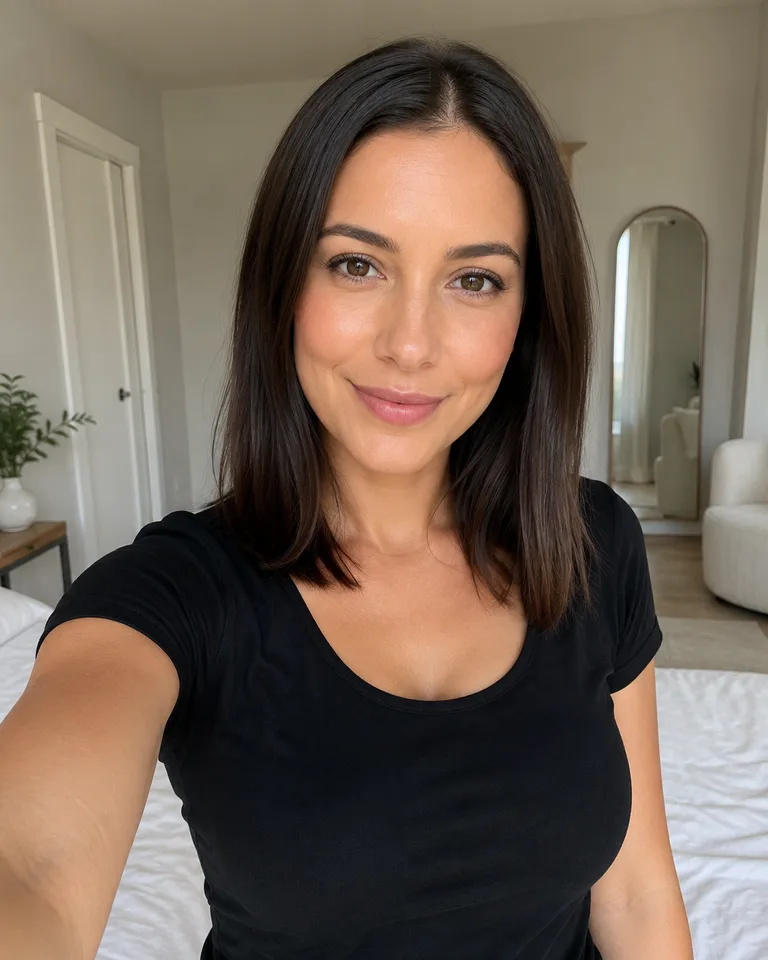
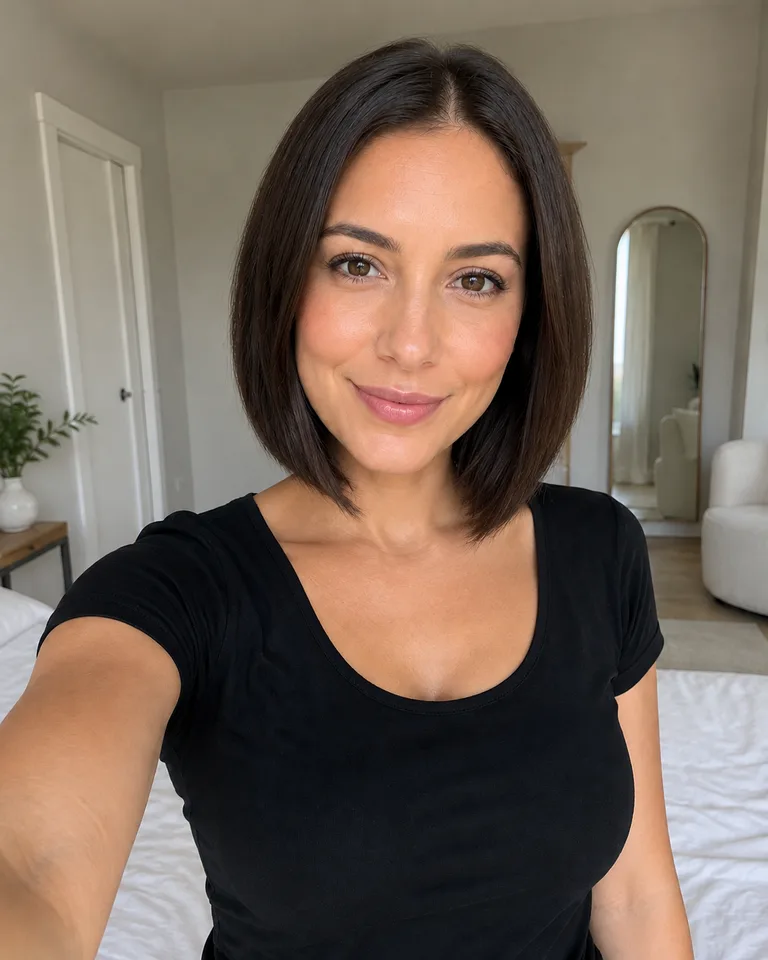
Here is the same method applied to a project demo portrait, recorded on October 10, 2026. The read came back as closest to oval, with medium uncertainty — the hair partly covered the sides and the camera angle made it a visual estimate rather than a measurement. The label did not end the exercise; it produced four directions from the same selfie:
One selfie, four directions from the same read
All four previews are AI-generated from the same photo. Each one changes the framing conversation: where the outline stops, how much forehead shows, and where the width sits.
The input selfie
Shoulder-length straight hair with a center part. The baseline every direction gets compared against.
Short A-line bob
The outline moves up to the jaw and the front pieces angle in toward the chin — a compact frame with visible neck.
Try this look
Medium wavy lob
Soft waves add width beside the cheeks and jaw. Same face, wider mid-frame, shorter-looking neck.
Try this look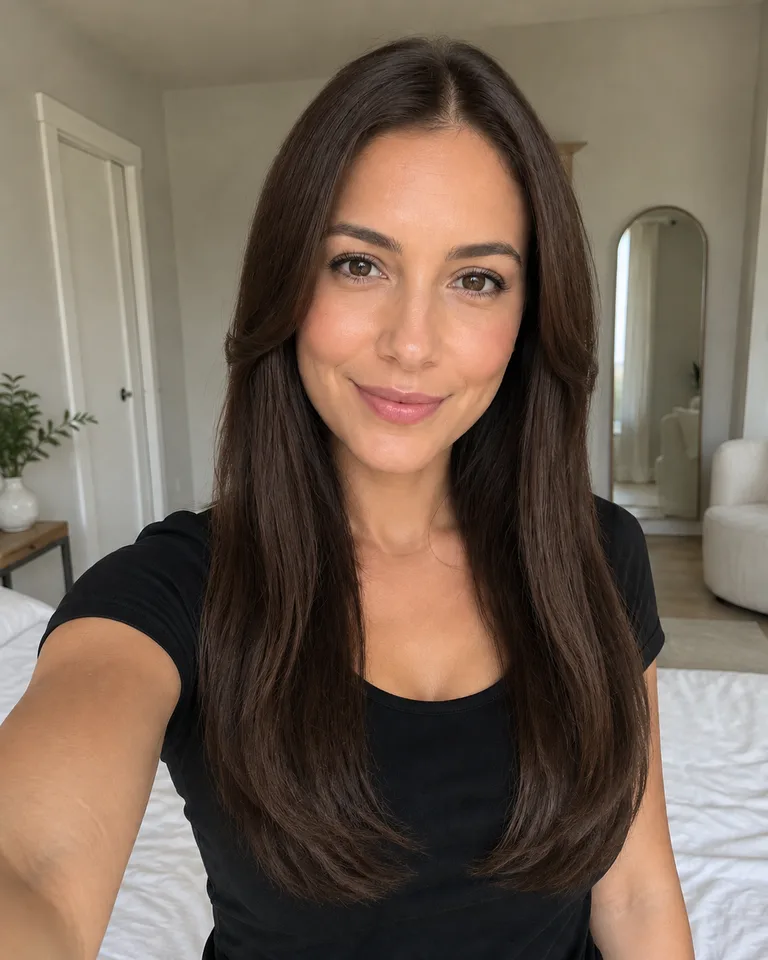
Long layers with curtain pieces
The frame extends below the shoulders and the forehead stays open. Vertical length changes the read more than anything else here.
Try this look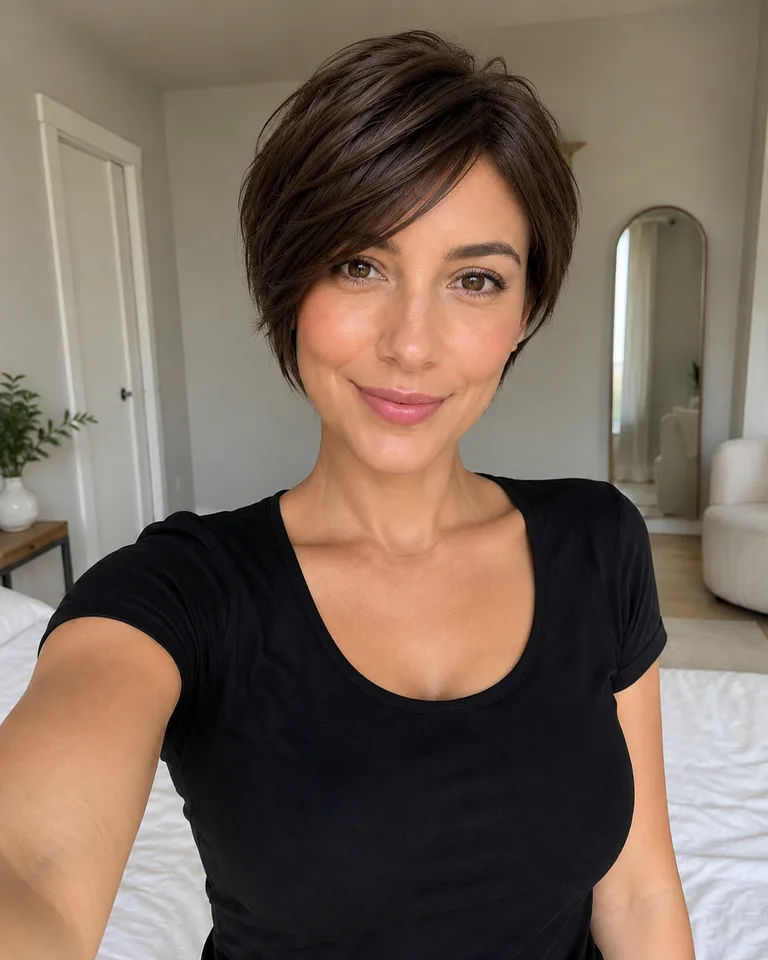
Short bixie with side bangs
The most open frame of the four: jaw and neck visible, with a diagonal fringe crossing the forehead.
Try this lookNotice what the four previews share: they answer framing questions the label never settled. That is the normal outcome, not a failed one.
What the Label Does Not Decide
A face-shape label suggests where to watch, and it forbids nothing. The framing work is done by four variables you can actually change:
- Where the ends stop. Jaw, shoulder, and collarbone endpoints each put the outline in a different zone relative to your face.
- Where volume sits. Crown volume adds height; side volume adds width; jaw-level volume shifts attention down.
- The part and front pieces. A center part treats both sides the same; a diagonal part creates movement across the face.
- Texture. Curls and waves change both the outline and the apparent density.
This is why the round-face ranked guide opens with volume placement rather than a rule about length, and why the same approach runs through the face-shape method guide. The label narrows the conversation; the variables do the work.
From Label to Shortlist
The working shortlist is deliberately spread, because a useful comparison needs contrast:
- One short option that opens the face — a bob or pixie direction.
- One medium option that frames the jaw — a lob or wavy shoulder-length direction.
- One long option that extends the outline — layers or waves below the shoulders.
Compare all three on the same photo, with the same lighting, and change one variable at a time. Best Hairstyle for My Face is built for this step: it reads your face from a selfie the way the recorded run above did, then previews curly bob, pixie, body wave, and loose wave directions on your own portrait so the shortlist becomes a real comparison instead of an article's opinion.
If the previews disagree with the label, trust the previews. The label came from one photo; the previews come from yours.
Where Face-Shape Reading Goes Wrong
The method fails in predictable ways, so check these before you trust your read:
- Hair over the temples or cheeks. The most common misread. Pull it back for the landmark photo, then let it down when you compare styles.
- An angled or smiling photo. Both change width readings. If you only have a smiling photo, note that the width numbers run high.
- Millimeter precision. Measuring to the millimeter gives you false confidence and an argument with yourself. The label tolerates error; hairstyle comparisons do the refining.
- Treating the label as a ban list. A round face does not forbid a bob, and a square face does not forbid short hair. If a rule forbids a whole category, it is a rule about trends, not faces.
Turn your label into previews
Bring the rough label and one clear portrait. Compare a short, a medium, and a long direction on your own face before you decide anything.
Preview looks for your faceFAQ
Can an AI tell me my face shape from a photo?
It can give a visual estimate, and it should come with uncertainty. In the recorded run above, the read was closest to oval with medium uncertainty — a reasonable answer, not a diagnosis. Camera angle, hair coverage, and expression all limit how far any photo-based read can go, including the AI's and yours.
What if I get a different shape every time I check?
Then your face reads as a mix, which is common. Take the two labels your readings keep landing on, borrow the shortlist advice from both rows of the table above, and compare directions from each side. The comparison resolves the tie more reliably than another quiz.
Does my face shape change over time?
The bone structure does not, but the visible outline does. Weight changes, aging, and how you wear your hair all shift what a photo reads. Re-check with a fresh photo if it has been a couple of years — or if your hair now covers landmarks it used to reveal.
Should I measure with a tape measure?
You can, and it will not help much. Tape-measure tests ask for precision the decision does not need, and they still fail on hair coverage and camera angle. Landmarks plus one ratio give you everything the label is going to be used for.
Which face shape is the most flattering?
None, in any way that guides a haircut. The flattering question is what a specific direction does to a specific face — where the outline stops, where volume sits, how much forehead shows. Labels describe; they do not rank.
How accurate does the label need to be?
Accurate enough to pick three contrasting directions. If your label is a coin flip between round and oval, preview short, medium, and long directions anyway — the preview will tell you more about which framing works than a more confident label would.